

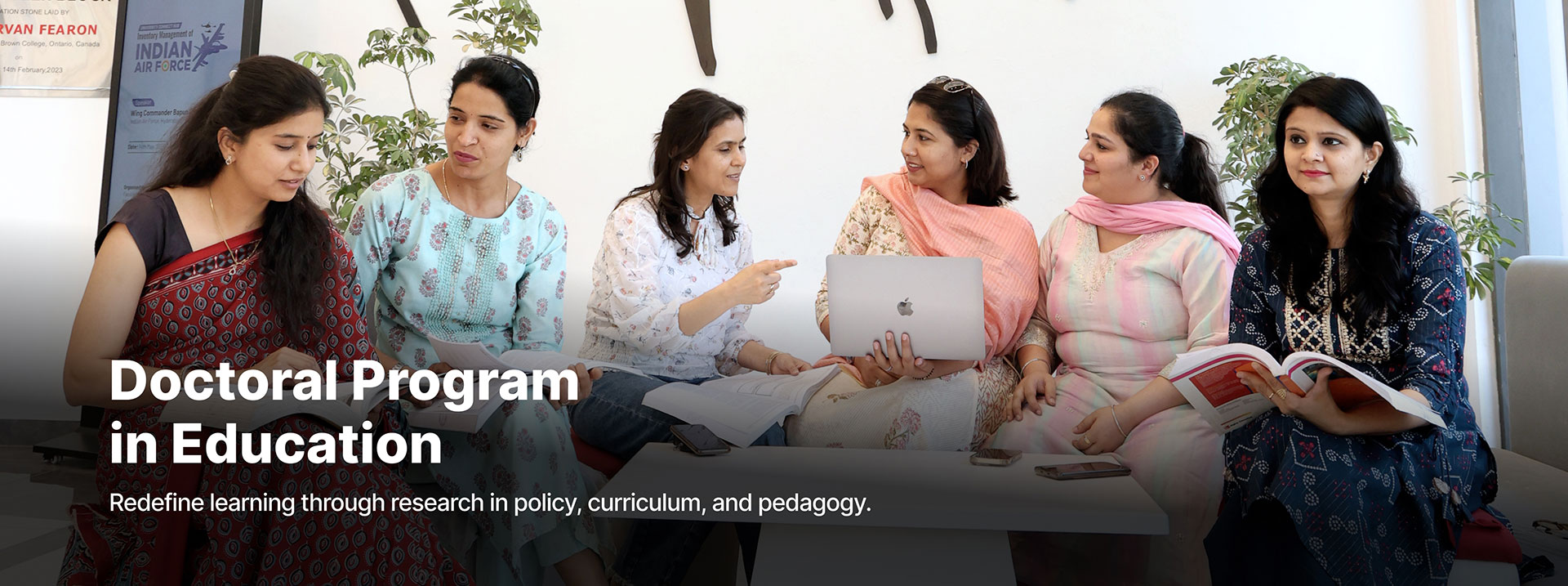

The PhD in Education Program at Chitkara University provides students with the skills and research opportunities to become theory-driven, transformative scholar advocates. The multidisciplinary program focuses on advancing educational sciences and contributing to improved educational opportunities and outcomes for individuals across the entire lifespan. By collaborating with world-class faculty and working in a diverse, burgeoning county with endless research opportunities, students are given the chance to address complex issues, problems, and inequities confronting society.
Additionally, Chitkara University’s PhD in Education program supports an inclusive learning space for students to develop into scholars who advocate for equity, diversity, and social justice. Students engage in innovative research that challenges traditional education models, equipping them to drive meaningful change and contribute to the evolution of educational practices globally. This program empowers students to create lasting impact through evidence-based practices and advocacy, fostering a transformative educational environment. The program also emphasises the development of critical thinking and ethical leadership, ensuring that graduates are well-prepared to influence policy and practice within educational systems worldwide.
The program’s required coursework will develop your knowledge of the interdisciplinary nature of education and expertise in a range of quantitative and qualitative methods needed to conduct high‑quality research. Guided by the goal of having a transformative impact on education research, policy, and practice, you will focus on independent research in various domains, including human development, learning and teaching, policy analysis and evaluation, institutions and society, and instructional practice. You will assume roles as university faculty, researchers, senior-level education leaders, and policymakers.
Furthermore, the PhD in Education degree program is led by a small group of world-class faculty with a strong commitment to equity in education and expertise in cultural and social aspects of education across contexts.

Program faculty draw from diverse theoretical perspectives and have a history of community engagement and policy work at the community, state, and national levels.
The PhD program at Chitkara University will prepare you for an outstanding career in research and teaching. Right from your first semester, you’ll get to work with faculty mentors across your field as you investigate the challenges that interest you. Our doctoral program students have the ability and diligence to study complex issues that the world right now faces.

Our PhD program equips scholars with skills beyond academia, preparing them for leadership, entrepreneurship, and industry roles. Through innovative pedagogy, mentoring, and hands-on learning, researchers gain critical thinking, problem-solving, and communication expertise, ensuring they excel in diverse professional landscapes beyond traditional academic settings.

PhD students present their work at leading conferences, engaging with experts and showcasing their research on international platforms. These opportunities expand academic visibility, foster collaborations, and provide insights into emerging trends, ensuring scholars stay ahead in their fields while strengthening their professional and scholarly impact.

Faculty mentors guide scholars through every stage of research, from idea generation to publication. Encouraged to collaborate with multiple faculty members, students gain diverse perspectives, fostering intellectual growth, refining research skills, and ensuring they navigate their academic journey with confidence and clarity.

Our PhD program thrives on interdisciplinary collaboration. Working with peers, faculty, and researchers, students engage in meaningful exchanges that enhance research quality. This team-driven approach fosters innovation, accelerates discoveries, and creates an environment where collective intelligence drives impactful and pioneering research.
The candidates who have completed any of the following qualification(s) are eligible to seek admission to the PhD program as per Chitkara University regulations and UGC Minimum Standards and Procedure for Award of PhD Degree Regulations, 2022 issued dated 07.11.2022 [(New Delhi, 7th November, 2022; No. F. 1-3/2021(QIP)].
Note: Relaxation for reserved categories as per UGC norms.
| Fee Components | Amount |
|---|---|
| Enrolment Fee | Rs. 30,000/- |
| Career Advancement Services Fee | Rs. 20,000/- |
| Course Work Fee 1 | Rs. 25,000/- |
| Course Work Fee 2 | Rs. 25,000/- |
| Course Work Fee 3 | Rs. 25,000/- |
| Doctoral Seminar on Specialisation | Rs. 60,000/- |
| Research Proposal Seminar | Rs. 60,000/- |
| Progress Review Seminar 1 | Rs. 20,000/- |
| Progress Review Seminar 2 | Rs. 20,000/- |
| Progress Review Seminar 3 | Rs. 20,000/- |
| Pre-Thesis Submission | Rs. 40,000/- |
| Thesis Submission & Defence | Rs. 75,000/- |
| Total | Rs. 4,20,000/- |

Candidates who fulfil the eligibility criteria, must fill the admission form with required documents of all particulars to be attached. All application forms will be screened by a separate screening committee whose representatives will be from Doctoral Research Committee and Experts from the University in the respective areas. Shortlisted candidates based on academic record and experience will appear for a written test conducted by the University.
The curriculum includes compulsory coursework, research proposal and objectives, research work and progress, pre-thesis work, and thesis defense.
The course work comprises of five components: research methodology, advanced research methodology, doctoral foundation seminar, doctoral concentration seminar, and research & publication ethics. After successfully completing coursework, the research scholar works in close coordination and under the strict supervision of his / her research guide, prepares the research proposal, and identifies the objectives of the research work.
Progress of the research work is reviewed every six months and finally, the scholars submit their thesis and defend it. The Doctoral Research Committee (DRC) closely mentors and monitors this process.
| Phase | Sub components | Outcome |
|---|---|---|
| Course Work | Research Methodology | Enabling scholars to pursue research in a methodical manner |
| Advanced Research Methodology | Enabling scholars to know about tools and technologies to process their data | |
| Doctoral Foundation Seminar | Enabling and equipping scholars with required tools and technologies in their broad discipline area | |
| Doctoral Concentration Seminar | a) Motivation to Research, b) identification of base paper(s), c) State‑of‑art, d) Identification of research gaps, e) Identification of Tools/Technologies for conducting proposed research | |
| Research & Publication Ethics | Sensitisation towards research; Ethics and respect to science and research integrity; Intellectual honesty and research integrity; Scientific misconducts; Falsification, Fabrication and Plagiarism | |
| Submission of Research Proposal | Extensive literature review / patent data bases, research proposal submitted to Dean (DRC) in prescribed format | |
| Progress Seminar – I | Progress on identified research objectives | |
| Progress Seminar – II | Progress on identified research objectives | |
| Progress Seminar – III | Progress on identified research objectives | |
| Pre Thesis Seminar | Achievement of all objectives, Thesis ready in final shape, Research paper(s) communicated to Conferences / Journals | |
| Thesis Submission and Defence | Eligibility for award of PhD degree |
Immerse yourself in applied high-tech research and complex topics alongside renowned faculty experts in our state-of-the-art research labs. Select from our future‑focused concentrations:
The steps you take today lay the foundation for your future success. At Chitkara University, we cultivate bright minds into changemakers, equipping them with strong fundamentals, a global perspective, and leadership skills to make a meaningful difference in the world.
The PhD in Education at Chitkara University is designed for scholars who aspire to redefine learning through research in policy, pedagogy, and curriculum. The program blends global research exposure with community-driven impact, empowering students to become transformative leaders in the field of education.
Yes, the program strongly emphasises equity, diversity, and social justice. Scholars explore issues such as educational disparities and systemic inequities, gaining tools to drive real change in both local and global education systems.
The full form of PhD in Education is “Doctor of Philosophy in Education.” Unlike an EdD (Doctor of Education), which is practice-oriented, a PhD emphasises theoretical research, policy-making, and academic scholarship aimed at advancing educational sciences.
Students can specialise in diverse research domains such as educational technology, curriculum development, educational psychology, pedagogy, e-learning, and environmental education, among others, allowing tailored research aligned with future challenges in education.
The university fosters a collaborative research culture, where scholars engage with peers, mentors, and industry experts across disciplines. This approach enhances research quality and prepares scholars to tackle education’s most complex, real-world problems.
Yes, Chitkara University’s program is designed to be flexible and personalised. Working professionals can manage their doctoral journey alongside their careers, with structured milestones like seminars, progress reviews, and guided thesis submission.
Absolutely. The PhD in Education in India at Chitkara University equips scholars with critical thinking, policy analysis, and leadership skills, making them ideal candidates for roles in higher education, government, NGOs, and international education bodies.
Chitkara University offers state-of-the-art research infrastructure, strong faculty mentorship, global conference exposure, and real-world application of theory. These features position it among the top choices for pursuing a PhD in Education in India.
Ideal applicants for the doctoral education program generally possess a Master’s degree in education or related fields. However, Chitkara University also welcomes candidates with significant teaching or research experience, fostering a diverse mix of academic and professional backgrounds.
The program’s blend of rigorous coursework, hands-on research, and mentoring develops skills essential for publishing, teaching, policy formulation, and consultancy, making it a solid foundation for careers in both academia and the education industry.
To apply for a PhD at Chitkara University, candidates must complete the online application form, submit necessary documents, and participate in an entrance test followed by a personal interview. The process ensures alignment between your research interests and university expertise.
Yes, Chitkara University conducts a PhD entrance examination designed to assess both subject knowledge and research aptitude. Candidates who qualify are then invited for a personal interview, where their research potential, preparedness, and motivation are further evaluated.
Applicants should submit a postgraduate degree certificate, mark sheets, ID proof, a research proposal, and, if applicable, NET/GATE scorecards. All documents must be verified during the admission process.
Yes, a preliminary research proposal or statement of purpose is generally required. It helps demonstrate your academic curiosity, research vision, and how it connects with Chitkara University’s doctoral programs.
The selection process includes a written entrance test and a personal interview. Candidates are shortlisted based on their academic qualifications, proposed research area, and performance in both.
Yes, if you’ve cleared UGC-NET, CSIR-NET, GATE, or similar national-level exams, you may be exempted from the entrance exam. However, the interview round is compulsory for all applicants.
PhD admissions at Chitkara University usually open twice a year, subject to the availability of research supervisors and approved seats. It’s best to check the official website regularly for updates.
To be eligible for a PhD at Chitkara University, you must have a Master’s degree or equivalent with at least 55% marks (or 50% for SC/ST/OBC/Other reserved categories) from a recognised university in a relevant field.
Yes, a Master’s degree is mandatory for admission into any PhD program at Chitkara University. Candidates from academic, research, or industry backgrounds are encouraged to apply if they meet the academic threshold.
No, qualifying UGC-NET or GATE is not mandatory for PhD admission at Chitkara University. However, candidates who have cleared UGC-NET, CSIR-NET, GATE, or other equivalent national-level examinations are exempted from the university’s entrance test. Such candidates are still required to appear for the interview round.
Yes, work experience is not compulsory for PhD admission. Fresh postgraduates with strong academic performance and a clear research vision are welcome to apply.
Yes, Chitkara University offers part-time PhD programs for working professionals who meet the academic eligibility requirements and can commit to periodic campus engagements and research milestones.
You need a relevant postgraduate qualification aligned with the PhD specialisation you’re applying for, like an M.Tech for Engineering PhD, or an M.Sc for Science-based programs. The match must support your research proposal.
No, there is no upper age limit for PhD applicants. As long as you meet the academic and eligibility requirements, you can apply at any stage in your academic or professional journey.
The PhD program fee at Chitkara University typically includes an annual tuition fee, registration charges, and other applicable university dues. Exact amounts may vary by specialisation and will be shared during the admission process.
Note: Fees may change without notice. Please check the latest details on our official fee page or contact the counsellor or the admissions team.
Yes, a non-refundable registration fee is required at the time of admission, which confirms your seat and includes administrative formalities. This fee is distinct from the annual tuition.
The fees for part-time PhD programs at Chitkara University are comparable to the full‑time structure, but may vary slightly depending on program logistics. It’s designed to remain accessible to working professionals.
Chitkara University does not offer merit-based scholarships for PhD programs at present. However, students may explore external funding agencies like UGC, CSIR, or ICSSR for eligible fellowships.
Yes, students can independently apply for education loans from banks and financial institutions. Chitkara University supports this process by providing the necessary documentation upon request.
While the base fee structure remains similar, certain specialisations may have additional costs related to lab facilities, fieldwork, or equipment. These will be clearly communicated during admission.
No stipend or assistantship is provided by Chitkara University directly. However, students with valid fellowships (NET-JRF, GATE, etc.) can continue to receive those benefits while enrolled.
Chitkara University offers PhD specialisations in 12 diverse fields: Business Management, Engineering, Architecture, Applied Sciences, Health Sciences, Art & Design, Mass Communication, Education, Psychology, Pharmaceutical Sciences, Nursing, and Law.
Yes, all doctoral candidates must complete mandatory coursework in the first year, including research methodology, advanced domain knowledge, and electives aligned with their chosen specialisation.
Absolutely. Chitkara University encourages interdisciplinary research, allowing scholars to integrate knowledge across departments, provided the research topic meets academic and supervisory criteria.
Yes, the PhD curriculum is domain-specific, with custom coursework, literature reviews, and seminar requirements based on each scholar’s field of study.
The curriculum is periodically revised to align with emerging research trends, regulatory norms, and global academic standards, ensuring scholars remain industry-ready and publication-ready.
Yes, scholars are expected to publish in peer‑reviewed journals, present at conferences, and engage in research-based academic writing as part of their doctoral milestones.
Yes, depending on the specialisation, elective courses and research seminars are available to help scholars deepen their expertise and broaden their research exposure.
Yes, Chitkara University offers strong industry exposure through partnerships, expert sessions, and research collaborations with leading organisations across various disciplines.
Absolutely. Scholars often engage in live research projects with industry partners, helping them gain real‑world insights and apply their academic knowledge effectively.
While traditional internships are not mandatory, PhD scholars are encouraged to undertake industry-based research collaborations, especially in applied and professional domains.
Chitkara University ensures alignment through advisory boards, MoUs with organisations, and research centres that bridge gaps between academia and industry needs.
Yes, many PhD scholars at Chitkara University co-author research papers with industry experts, enhancing both academic and practical value.
Depending on the domain, scholars collaborate with sectors like healthcare, IT, pharmaceuticals, law, education, media, architecture, and business consulting.
Yes, while the nature varies, industry exposure is integrated across all PhD programs, ensuring relevant opportunities for each field of research.
The RAC monitors the scholar’s research journey, offers academic guidance, approves research plans, and evaluates progress reports at each stage. Their feedback directly influences the scholar’s continuation and thesis submission readiness.
While internal evaluations are conducted regularly, external experts may be invited during key milestones such as synopsis defence or final viva to provide unbiased academic input.
Yes, a pre-thesis submission review is conducted to ensure research quality, publication compliance, and alignment with academic standards before final thesis submission.
Absolutely. Evaluation includes performance in mandatory coursework, research proposal defence, ongoing progress reviews, and successful completion of research publications and thesis.
If a scholar fails to demonstrate satisfactory progress, the RAC may recommend additional support, revise timelines, or, in rare cases, advise discontinuation from the program following due academic process.
Progress presentations are generally held once every semester. This allows scholars to showcase their work, receive feedback from faculty, and meet mandatory research benchmarks.
Yes, scholars undergo bi-annual or annual reviews where they present their research progress to the Research Advisory Committee (RAC). These reviews are critical for ensuring timely completion and academic rigour.
Full-time PhD scholars who meet academic performance criteria and demonstrate strong research potential may be considered for university-sponsored or project-based fellowships.
The stipend amount may vary based on the type of fellowship, duration, and funding source. Scholars are advised to check with the university’s PhD Cell for current fellowship structures.
Yes, fellowship opportunities are available across various PhD disciplines, subject to seat availability, quality of the research proposal, and funding alignment with the chosen domain.
Eligible candidates can indicate their interest in applying for a fellowship during the PhD application process. The final selection is based on academic merit, interview performance, and the availability of funds.
Yes, scholars working on industry or government-funded research projects may receive stipends as per project guidelines and investigator recommendations.
Absolutely. PhD scholars with UGC-NET JRF, CSIR, or other government-sponsored fellowships can pursue their research at Chitkara University, subject to fulfilling admission criteria.
Fellowships are generally awarded for a fixed duration (e.g., 3 years) and are subject to annual renewal based on satisfactory academic progress and RAC approvals.
PhD graduates from Chitkara University can pursue careers in academia, research and development, consulting, policy-making, publishing, and senior roles in industry. The program builds expertise for leadership in both academic and corporate sectors.
Yes, the university assists scholars in pursuing faculty roles, postdoctoral fellowships, and academic collaborations through networking events, career support, and research exposure.
Absolutely. Many PhD graduates take up roles in research-driven industries, think tanks, innovation labs, and consulting firms, depending on their area of specialisation and research focus.
Yes, Chitkara University actively encourages PhD scholars to embrace entrepreneurship through its dedicated innovation and incubation centres. These platforms empower researchers to transform their ideas into viable startups or commercial ventures across diverse fields such as technology, healthcare, education, and design.
Yes, scholars receive mentorship and editorial support to publish in Scopus, UGC-CARE, and other peer‑reviewed journals, enhancing their academic and professional visibility.
Yes, Chitkara University has global academic partnerships that allow scholars to engage in joint research, attend international conferences, and co-author papers with global experts.
Yes, with strong academic guidance and publication records, Chitkara University PhD graduates are well‑prepared to apply for post‑doctoral positions in reputed international universities and research centres.
While traditional placements are limited for PhD programs, the university connects scholars with academic institutions, research organisations, and industry collaborators for career opportunities.
Chitkara University offers world-class research infrastructure, including domain-specific labs, high-end computing resources, advanced simulation software, and research centres of excellence across disciplines.
Yes, Chitkara University offers dedicated research and innovation centres across diverse domains, including engineering, healthcare, business, design, media, and emerging technologies. These centres provide a strong ecosystem to support and advance in-depth doctoral research.
Absolutely. Scholars have access to Scopus, JSTOR, Springer, IEEE, Elsevier, and other top academic databases through the digital library, enabling high-quality literature reviews and citations.
Yes, Chitkara University has a centrally equipped library with thousands of print volumes, digital subscriptions, research publications, and private study spaces dedicated to PhD scholars.
Yes, each department has customised research labs, such as wet labs for biosciences, innovation labs for engineering, and analytics labs for business research, equipped with modern tools.
Yes, scholars are provided access to statistical analysis software (SPSS, R, Python), AI tools, design software, and simulation platforms based on their research needs.
Yes, the entire campus is Wi-Fi enabled, ensuring seamless internet access in libraries, labs, and research centres to support continuous research and collaboration.
Yes, PhD scholars can utilise well-equipped seminar halls, auditoriums, and breakout rooms for presentations, research discussions, and guest lectures.
Yes, PhD scholars at Chitkara University have access to global research collaborations through MoUs with international universities, joint research projects, and faculty exchange programs.
Yes, PhD scholars at Chitkara University have the opportunity to publish research in collaboration with international faculty. Many co-authored papers with global mentors or researchers, particularly through partnered projects or during international research exchanges.
Yes, Chitkara University encourages and supports scholars to present papers at international conferences, with options for travel grants or academic sponsorships in select cases.
Yes, Chitkara University maintains strategic partnerships with global institutions across countries like the USA, Canada, Australia, Germany, and the UK to support academic exchange and joint research.
In select research areas, Chitkara University may offer joint supervision or co-guidance models with international faculty, enhancing global credibility and research depth.
Yes, eligible PhD scholars may apply for short‑term international research visits, internships, or summer schools at partner universities for practical exposure.
Yes, external reviewers or examiners from reputed foreign institutions may be invited to evaluate PhD theses, especially during the final viva or pre-thesis submission stages.
Yes, scholars receive guidance on applying for international fellowships, grants, and funded programs like Erasmus+, DAAD, or Commonwealth Scholarships.
While full-semester exchanges are rare, short‑term academic exchanges and project‑based collaborations are possible through Chitkara University’s international partnerships.
Chitkara University is known for its research-driven ecosystem, global academic partnerships, experienced faculty, and cutting-edge infrastructure, making it a top destination for PhD aspirants across disciplines.
Yes, Chitkara University is a UGC-recognised institution and follows all regulatory guidelines for its doctoral programs, ensuring credibility and academic rigour.
The university fosters innovation through centres of excellence, interdisciplinary labs, funding opportunities, patent support, and entrepreneurship programs, encouraging scholars to turn ideas into impactful outcomes.
PhD scholars have access to Scopus-indexed journals, digital databases, well-equipped libraries, simulation tools, and international faculty networks, ensuring a robust academic experience.
Yes, Chitkara University promotes a high-performance research culture with structured mentoring, peer‑review practices, ethics compliance, and regular progress reviews.
Absolutely. Chitkara University offers interdisciplinary PhD programs across engineering, health sciences, media, business, architecture, psychology, law, and more.
Scholars are guided by highly qualified, research-active faculty with national and international exposure. Faculty provide ongoing academic, technical, and career mentoring.
The campus offers a quiet, well-resourced, and digitally enabled environment with 24/7 Wi-Fi, innovation hubs, collaborative spaces, and modern accommodation options for research scholars.
Yes, Chitkara University offers a highly secure and well-monitored campus, with 24/7 surveillance, gated entry, and dedicated hostel wardens to ensure a safe and peaceful environment for research scholars.
Yes, the university provides well-furnished, secure hostels and faculty residences for full‑time PhD scholars, offering a comfortable and research-friendly living environment.
PhD scholars are mentored by highly qualified faculty with doctoral degrees, strong research portfolios, and international experience, ensuring academic excellence and guidance throughout the program.
Absolutely. Chitkara University is a UGC-recognised institution and conducts PhD programs as per the latest UGC (Minimum Standards and Procedure) Regulations.
Yes, Chitkara University supports scholars in publishing in reputed journals, offering mentorship, editorial guidance, and access to top research databases and writing tools.
PhD graduates from Chitkara University go on to build careers in academia, research, consulting, industry R&D, policy-making, and international postdoctoral programs.
The campus includes a fully equipped medical centre, wellness counselling services, and emergency care, ensuring the physical and mental well-being of scholars.
Yes, eligible full-time scholars may receive university fellowships, project‑based stipends, or assistance in applying for external funding like UGC‑NET JRF or CSIR grants.
Yes, Chitkara University offers part-time PhD programs specially designed for working professionals, allowing them to balance research with their existing job commitments.
The PhD program typically takes a minimum of 3 years and can be extended up to 6 years, with flexibility for both full-time and part-time scholars as per UGC guidelines.
Yes, the university offers weekend workshops, virtual research discussions, and flexible seminar schedules to accommodate the availability of working professionals.
Absolutely. Chitkara University supports online mentoring, video conferencing, and digital communication tools to help scholars stay in touch with their supervisors from any location.
Yes, many scholars successfully pursue their PhD while working. The program structure offers customised timelines, virtual meetings, and research support tailored for professionals.
Employed scholars can request academic leave from their employers, and the university provides official letters and documentation to support such requests when needed.
Yes, RAC meetings and progress presentations are scheduled in advance and can be aligned with the scholar’s professional commitments to ensure smooth participation.
Yes, Chitkara University follows a blended learning model, combining in‑person workshops with online sessions, digital libraries, and remote collaboration tools for maximum flexibility.
Faculty mentors guide scholars on effective research planning, milestone setting, and balancing work‑study responsibilities, ensuring steady progress throughout the program.
The PhD in Education at Chitkara University is designed for scholars who aspire to redefine learning through research in policy, pedagogy, and curriculum. The program blends global research exposure with community-driven impact, empowering students to become transformative leaders in the field of education.
Yes, the program strongly emphasises equity, diversity, and social justice. Scholars explore issues such as educational disparities and systemic inequities, gaining tools to drive real change in both local and global education systems.
The full form of PhD in Education is “Doctor of Philosophy in Education.” Unlike an EdD (Doctor of Education), which is practice-oriented, a PhD emphasises theoretical research, policy-making, and academic scholarship aimed at advancing educational sciences.
Students can specialise in diverse research domains such as educational technology, curriculum development, educational psychology, pedagogy, e-learning, and environmental education, among others, allowing tailored research aligned with future challenges in education.
The university fosters a collaborative research culture, where scholars engage with peers, mentors, and industry experts across disciplines. This approach enhances research quality and prepares scholars to tackle education’s most complex, real-world problems.
Yes, Chitkara University’s program is designed to be flexible and personalised. Working professionals can manage their doctoral journey alongside their careers, with structured milestones like seminars, progress reviews, and guided thesis submission.
Absolutely. The PhD in Education in India at Chitkara University equips scholars with critical thinking, policy analysis, and leadership skills, making them ideal candidates for roles in higher education, government, NGOs, and international education bodies.
Chitkara University offers state-of-the-art research infrastructure, strong faculty mentorship, global conference exposure, and real-world application of theory. These features position it among the top choices for pursuing a PhD in Education in India.
Ideal applicants for the doctoral education program generally possess a Master’s degree in education or related fields. However, Chitkara University also welcomes candidates with significant teaching or research experience, fostering a diverse mix of academic and professional backgrounds.
The program’s blend of rigorous coursework, hands-on research, and mentoring develops skills essential for publishing, teaching, policy formulation, and consultancy, making it a solid foundation for careers in both academia and the education industry.
To apply for a PhD at Chitkara University, candidates must complete the online application form, submit necessary documents, and participate in an entrance test followed by a personal interview. The process ensures alignment between your research interests and university expertise.
Yes, Chitkara University conducts a PhD entrance examination designed to assess both subject knowledge and research aptitude. Candidates who qualify are then invited for a personal interview, where their research potential, preparedness, and motivation are further evaluated.
Applicants should submit a postgraduate degree certificate, mark sheets, ID proof, a research proposal, and, if applicable, NET/GATE scorecards. All documents must be verified during the admission process.
Yes, a preliminary research proposal or statement of purpose is generally required. It helps demonstrate your academic curiosity, research vision, and how it connects with Chitkara University’s doctoral programs.
The selection process includes a written entrance test and a personal interview. Candidates are shortlisted based on their academic qualifications, proposed research area, and performance in both.
Yes, if you’ve cleared UGC-NET, CSIR-NET, GATE, or similar national-level exams, you may be exempted from the entrance exam. However, the interview round is compulsory for all applicants.
PhD admissions at Chitkara University usually open twice a year, subject to the availability of research supervisors and approved seats. It’s best to check the official website regularly for updates.
To be eligible for a PhD at Chitkara University, you must have a Master’s degree or equivalent with at least 55% marks (or 50% for SC/ST/OBC/Other reserved categories) from a recognised university in a relevant field.
Yes, a Master’s degree is mandatory for admission into any PhD program at Chitkara University. Candidates from academic, research, or industry backgrounds are encouraged to apply if they meet the academic threshold.
No, qualifying UGC-NET or GATE is not mandatory for PhD admission at Chitkara University. However, candidates who have cleared UGC-NET, CSIR-NET, GATE, or other equivalent national-level examinations are exempted from the university’s entrance test. Such candidates are still required to appear for the interview round.
Yes, work experience is not compulsory for PhD admission. Fresh postgraduates with strong academic performance and a clear research vision are welcome to apply.
Yes, Chitkara University offers part-time PhD programs for working professionals who meet the academic eligibility requirements and can commit to periodic campus engagements and research milestones.
You need a relevant postgraduate qualification aligned with the PhD specialisation you’re applying for, like an M.Tech for Engineering PhD, or an M.Sc for Science-based programs. The match must support your research proposal.
No, there is no upper age limit for PhD applicants. As long as you meet the academic and eligibility requirements, you can apply at any stage in your academic or professional journey.
The PhD program fee at Chitkara University typically includes an annual tuition fee, registration charges, and other applicable university dues. Exact amounts may vary by specialisation and will be shared during the admission process.
Note: Fees may change without notice. Please check the latest details on our official fee page or contact the counsellor or the admissions team.
Yes, a non-refundable registration fee is required at the time of admission, which confirms your seat and includes administrative formalities. This fee is distinct from the annual tuition.
The fees for part-time PhD programs at Chitkara University are comparable to the full‑time structure, but may vary slightly depending on program logistics. It’s designed to remain accessible to working professionals.
Chitkara University does not offer merit-based scholarships for PhD programs at present. However, students may explore external funding agencies like UGC, CSIR, or ICSSR for eligible fellowships.
Yes, students can independently apply for education loans from banks and financial institutions. Chitkara University supports this process by providing the necessary documentation upon request.
While the base fee structure remains similar, certain specialisations may have additional costs related to lab facilities, fieldwork, or equipment. These will be clearly communicated during admission.
No stipend or assistantship is provided by Chitkara University directly. However, students with valid fellowships (NET-JRF, GATE, etc.) can continue to receive those benefits while enrolled.
Chitkara University offers PhD specialisations in 12 diverse fields: Business Management, Engineering, Architecture, Applied Sciences, Health Sciences, Art & Design, Mass Communication, Education, Psychology, Pharmaceutical Sciences, Nursing, and Law.
Yes, all doctoral candidates must complete mandatory coursework in the first year, including research methodology, advanced domain knowledge, and electives aligned with their chosen specialisation.
Absolutely. Chitkara University encourages interdisciplinary research, allowing scholars to integrate knowledge across departments, provided the research topic meets academic and supervisory criteria.
Yes, the PhD curriculum is domain-specific, with custom coursework, literature reviews, and seminar requirements based on each scholar’s field of study.
The curriculum is periodically revised to align with emerging research trends, regulatory norms, and global academic standards, ensuring scholars remain industry-ready and publication-ready.
Yes, scholars are expected to publish in peer‑reviewed journals, present at conferences, and engage in research-based academic writing as part of their doctoral milestones.
Yes, depending on the specialisation, elective courses and research seminars are available to help scholars deepen their expertise and broaden their research exposure.
Yes, Chitkara University offers strong industry exposure through partnerships, expert sessions, and research collaborations with leading organisations across various disciplines.
Absolutely. Scholars often engage in live research projects with industry partners, helping them gain real‑world insights and apply their academic knowledge effectively.
While traditional internships are not mandatory, PhD scholars are encouraged to undertake industry-based research collaborations, especially in applied and professional domains.
Chitkara University ensures alignment through advisory boards, MoUs with organisations, and research centres that bridge gaps between academia and industry needs.
Yes, many PhD scholars at Chitkara University co-author research papers with industry experts, enhancing both academic and practical value.
Depending on the domain, scholars collaborate with sectors like healthcare, IT, pharmaceuticals, law, education, media, architecture, and business consulting.
Yes, while the nature varies, industry exposure is integrated across all PhD programs, ensuring relevant opportunities for each field of research.
The RAC monitors the scholar’s research journey, offers academic guidance, approves research plans, and evaluates progress reports at each stage. Their feedback directly influences the scholar’s continuation and thesis submission readiness.
While internal evaluations are conducted regularly, external experts may be invited during key milestones such as synopsis defence or final viva to provide unbiased academic input.
Yes, a pre-thesis submission review is conducted to ensure research quality, publication compliance, and alignment with academic standards before final thesis submission.
Absolutely. Evaluation includes performance in mandatory coursework, research proposal defence, ongoing progress reviews, and successful completion of research publications and thesis.
If a scholar fails to demonstrate satisfactory progress, the RAC may recommend additional support, revise timelines, or, in rare cases, advise discontinuation from the program following due academic process.
Progress presentations are generally held once every semester. This allows scholars to showcase their work, receive feedback from faculty, and meet mandatory research benchmarks.
Yes, scholars undergo bi-annual or annual reviews where they present their research progress to the Research Advisory Committee (RAC). These reviews are critical for ensuring timely completion and academic rigour.
Full-time PhD scholars who meet academic performance criteria and demonstrate strong research potential may be considered for university-sponsored or project-based fellowships.
The stipend amount may vary based on the type of fellowship, duration, and funding source. Scholars are advised to check with the university’s PhD Cell for current fellowship structures.
Yes, fellowship opportunities are available across various PhD disciplines, subject to seat availability, quality of the research proposal, and funding alignment with the chosen domain.
Eligible candidates can indicate their interest in applying for a fellowship during the PhD application process. The final selection is based on academic merit, interview performance, and the availability of funds.
Yes, scholars working on industry or government-funded research projects may receive stipends as per project guidelines and investigator recommendations.
Absolutely. PhD scholars with UGC-NET JRF, CSIR, or other government-sponsored fellowships can pursue their research at Chitkara University, subject to fulfilling admission criteria.
Fellowships are generally awarded for a fixed duration (e.g., 3 years) and are subject to annual renewal based on satisfactory academic progress and RAC approvals.
PhD graduates from Chitkara University can pursue careers in academia, research and development, consulting, policy-making, publishing, and senior roles in industry. The program builds expertise for leadership in both academic and corporate sectors.
Yes, the university assists scholars in pursuing faculty roles, postdoctoral fellowships, and academic collaborations through networking events, career support, and research exposure.
Absolutely. Many PhD graduates take up roles in research-driven industries, think tanks, innovation labs, and consulting firms, depending on their area of specialisation and research focus.
Yes, Chitkara University actively encourages PhD scholars to embrace entrepreneurship through its dedicated innovation and incubation centres. These platforms empower researchers to transform their ideas into viable startups or commercial ventures across diverse fields such as technology, healthcare, education, and design.
Yes, scholars receive mentorship and editorial support to publish in Scopus, UGC-CARE, and other peer‑reviewed journals, enhancing their academic and professional visibility.
Yes, Chitkara University has global academic partnerships that allow scholars to engage in joint research, attend international conferences, and co-author papers with global experts.
Yes, with strong academic guidance and publication records, Chitkara University PhD graduates are well‑prepared to apply for post‑doctoral positions in reputed international universities and research centres.
While traditional placements are limited for PhD programs, the university connects scholars with academic institutions, research organisations, and industry collaborators for career opportunities.
Chitkara University offers world-class research infrastructure, including domain-specific labs, high-end computing resources, advanced simulation software, and research centres of excellence across disciplines.
Yes, Chitkara University offers dedicated research and innovation centres across diverse domains, including engineering, healthcare, business, design, media, and emerging technologies. These centres provide a strong ecosystem to support and advance in-depth doctoral research.
Absolutely. Scholars have access to Scopus, JSTOR, Springer, IEEE, Elsevier, and other top academic databases through the digital library, enabling high-quality literature reviews and citations.
Yes, Chitkara University has a centrally equipped library with thousands of print volumes, digital subscriptions, research publications, and private study spaces dedicated to PhD scholars.
Yes, each department has customised research labs, such as wet labs for biosciences, innovation labs for engineering, and analytics labs for business research, equipped with modern tools.
Yes, scholars are provided access to statistical analysis software (SPSS, R, Python), AI tools, design software, and simulation platforms based on their research needs.
Yes, the entire campus is Wi-Fi enabled, ensuring seamless internet access in libraries, labs, and research centres to support continuous research and collaboration.
Yes, PhD scholars can utilise well-equipped seminar halls, auditoriums, and breakout rooms for presentations, research discussions, and guest lectures.
Yes, PhD scholars at Chitkara University have access to global research collaborations through MoUs with international universities, joint research projects, and faculty exchange programs.
Yes, PhD scholars at Chitkara University have the opportunity to publish research in collaboration with international faculty. Many co-authored papers with global mentors or researchers, particularly through partnered projects or during international research exchanges.
Yes, Chitkara University encourages and supports scholars to present papers at international conferences, with options for travel grants or academic sponsorships in select cases.
Yes, Chitkara University maintains strategic partnerships with global institutions across countries like the USA, Canada, Australia, Germany, and the UK to support academic exchange and joint research.
In select research areas, Chitkara University may offer joint supervision or co-guidance models with international faculty, enhancing global credibility and research depth.
Yes, eligible PhD scholars may apply for short‑term international research visits, internships, or summer schools at partner universities for practical exposure.
Yes, external reviewers or examiners from reputed foreign institutions may be invited to evaluate PhD theses, especially during the final viva or pre-thesis submission stages.
Yes, scholars receive guidance on applying for international fellowships, grants, and funded programs like Erasmus+, DAAD, or Commonwealth Scholarships.
While full-semester exchanges are rare, short‑term academic exchanges and project‑based collaborations are possible through Chitkara University’s international partnerships.
Chitkara University is known for its research-driven ecosystem, global academic partnerships, experienced faculty, and cutting-edge infrastructure, making it a top destination for PhD aspirants across disciplines.
Yes, Chitkara University is a UGC-recognised institution and follows all regulatory guidelines for its doctoral programs, ensuring credibility and academic rigour.
The university fosters innovation through centres of excellence, interdisciplinary labs, funding opportunities, patent support, and entrepreneurship programs, encouraging scholars to turn ideas into impactful outcomes.
PhD scholars have access to Scopus-indexed journals, digital databases, well-equipped libraries, simulation tools, and international faculty networks, ensuring a robust academic experience.
Yes, Chitkara University promotes a high-performance research culture with structured mentoring, peer‑review practices, ethics compliance, and regular progress reviews.
Absolutely. Chitkara University offers interdisciplinary PhD programs across engineering, health sciences, media, business, architecture, psychology, law, and more.
Scholars are guided by highly qualified, research-active faculty with national and international exposure. Faculty provide ongoing academic, technical, and career mentoring.
The campus offers a quiet, well-resourced, and digitally enabled environment with 24/7 Wi-Fi, innovation hubs, collaborative spaces, and modern accommodation options for research scholars.
Yes, Chitkara University offers a highly secure and well-monitored campus, with 24/7 surveillance, gated entry, and dedicated hostel wardens to ensure a safe and peaceful environment for research scholars.
Yes, the university provides well-furnished, secure hostels and faculty residences for full‑time PhD scholars, offering a comfortable and research-friendly living environment.
PhD scholars are mentored by highly qualified faculty with doctoral degrees, strong research portfolios, and international experience, ensuring academic excellence and guidance throughout the program.
Absolutely. Chitkara University is a UGC-recognised institution and conducts PhD programs as per the latest UGC (Minimum Standards and Procedure) Regulations.
Yes, Chitkara University supports scholars in publishing in reputed journals, offering mentorship, editorial guidance, and access to top research databases and writing tools.
PhD graduates from Chitkara University go on to build careers in academia, research, consulting, industry R&D, policy-making, and international postdoctoral programs.
The campus includes a fully equipped medical centre, wellness counselling services, and emergency care, ensuring the physical and mental well-being of scholars.
Yes, eligible full-time scholars may receive university fellowships, project‑based stipends, or assistance in applying for external funding like UGC‑NET JRF or CSIR grants.
Yes, Chitkara University offers part-time PhD programs specially designed for working professionals, allowing them to balance research with their existing job commitments.
The PhD program typically takes a minimum of 3 years and can be extended up to 6 years, with flexibility for both full-time and part-time scholars as per UGC guidelines.
Yes, the university offers weekend workshops, virtual research discussions, and flexible seminar schedules to accommodate the availability of working professionals.
Absolutely. Chitkara University supports online mentoring, video conferencing, and digital communication tools to help scholars stay in touch with their supervisors from any location.
Yes, many scholars successfully pursue their PhD while working. The program structure offers customised timelines, virtual meetings, and research support tailored for professionals.
Employed scholars can request academic leave from their employers, and the university provides official letters and documentation to support such requests when needed.
Yes, RAC meetings and progress presentations are scheduled in advance and can be aligned with the scholar’s professional commitments to ensure smooth participation.
Yes, Chitkara University follows a blended learning model, combining in‑person workshops with online sessions, digital libraries, and remote collaboration tools for maximum flexibility.
Faculty mentors guide scholars on effective research planning, milestone setting, and balancing work‑study responsibilities, ensuring steady progress throughout the program.



Chandigarh-Patiala National Highway, Punjab 140 401
Unit No. A 201-202, Elante Mall Office Complex
Industrial Area Phase 1, Chandigarh 160 002
Copyright © 2026 Chitkara Educational Trust
Unit No. A 201-202
Elante Mall Office Complex
Industrial Area Phase 1
Chandigarh 160 002
Chandigarh-Patiala National Highway
Punjab 140 401


