
DummyTo be recognized as a centre of excellence in Electronics and Communication Engineering education and research, fostering innovation and advancing sustainable technological progress to address societal needs.
Communication lab supports courses in Analog & Digital Communication and Wireless Mobile Communication. It provides hands-on experience with modern communication systems, including modulation and demodulation techniques, antenna designing and characterization, and GSM. Students gain practical skills in signal transmission, reception, and analysis using measuring instruments such as the spectrum analyzer, effectively linking core theory to real-world applications like mobile networks and satellite communications.
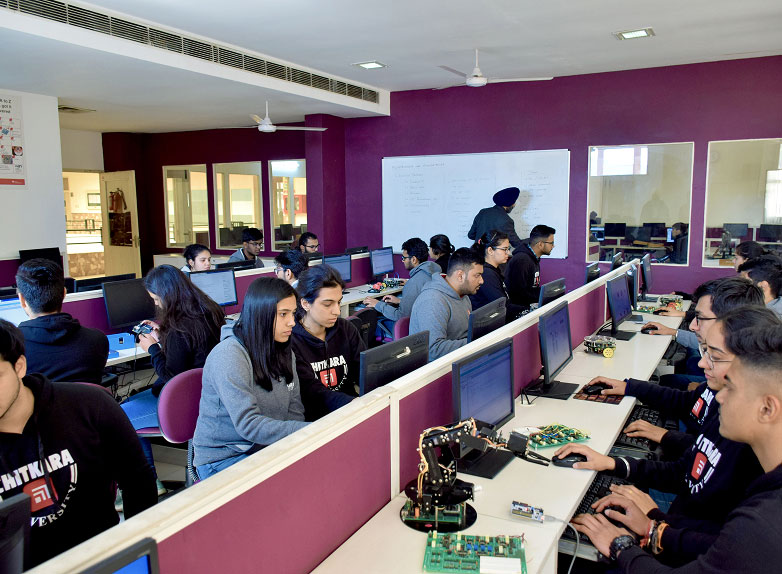
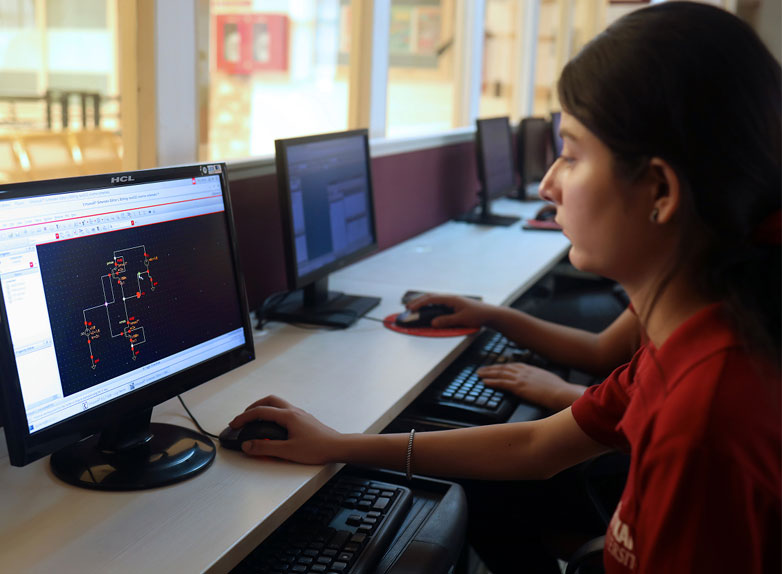
The VLSI Laboratory provides advanced, industry-aligned training in analog/digital IC design, layout methodologies, and FPGA-based digital system prototyping. Central to its infrastructure is the Cadence Electronic Design Automation (EDA) tool suite, which enables students to engage with the complete VLSI design flow—from schematic entry and simulation to physical layout, verification, and FPGA implementation. The lab benefits from a strategic partnership with NXP Semiconductors, fostering significant industry–academia collaboration through expert-led workshops and specialized training in analog and mixed-signal layout design. This rigorous practical exposure effectively prepares graduates for the semiconductor workforce, and they are absorbed by leading firms like NXP and Micron, supporting national initiatives such as the India Semiconductor Mission.
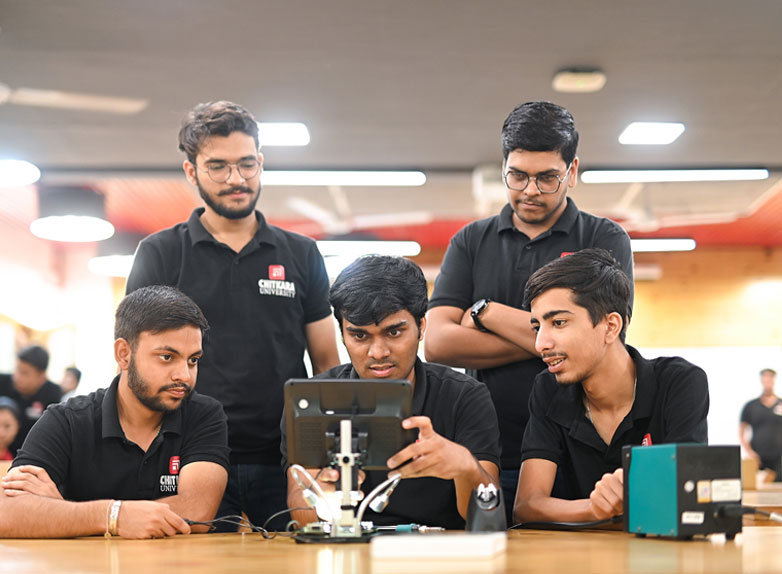
The Electronique Design Centre (EDC) functions as a state-of-the-art innovation hub dedicated to electronics prototyping, applied research, and experiential learning. It primarily supports Capstone Projects I & II, providing students with advanced instrumentation, prototyping tools, and mentorship to develop practical electronics design and system integration skills. Furthermore, the Centre hosts a specialized Cyber-Physical Systems (CPS) Laboratory, established in collaboration with AWaDH, IIT Ropar. This initiative is aligned with the National Mission on Interdisciplinary Cyber-Physical Systems (NM-ICPS) under the Department of Science and Technology, focusing on skilling students in foundational and emerging CPS technologies to address contemporary engineering challenges.
The IoT Innovation Laboratory is a specialized facility supporting courses in IoT Application Development, Cloud Computing for IoT, and Embedded AI. It is equipped with modern development kits featuring STM32 microcontrollers, comprehensive sensor and actuator modules, and industry-relevant cloud platforms such as AWS, Edge Impulse, Thingspeak and Blynk. Within this environment, students gain practical experience in architecting complete, end-to-end IoT systems. This includes hands-on work in embedded sensor data acquisition, edge-based computation, secure cloud integration, and data analytics. The lab’s experiential learning framework is designed to equip students with the necessary skills to innovate and contribute effectively in the rapidly advancing smart technology and connected systems sector.
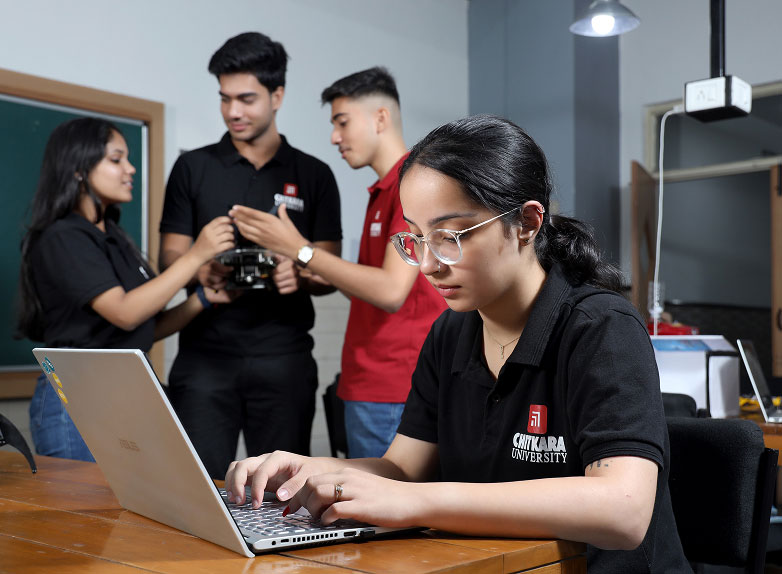
The Measurements and Virtual Instrumentation Laboratory provide essential infrastructure for the Linear Control Systems course. Its core instrumentation includes the National Instruments Educational Laboratory Virtual Instrumentation Suite (NI ELVIS) hardware platform and LabVIEW software. In this dedicated facility, students engage in designing and implementing sophisticated virtual instruments for data acquisition, real-time process monitoring, control system implementation, and dynamic system analysis. By bridging foundational control theory with practical application, the laboratory enables hands-on experimentation in hardware interfacing, feedback loop development, and comprehensive system performance evaluation. This experiential learning environment is designed to impart critical skills in modern instrumentation, measurement methodologies, and automated control system design.
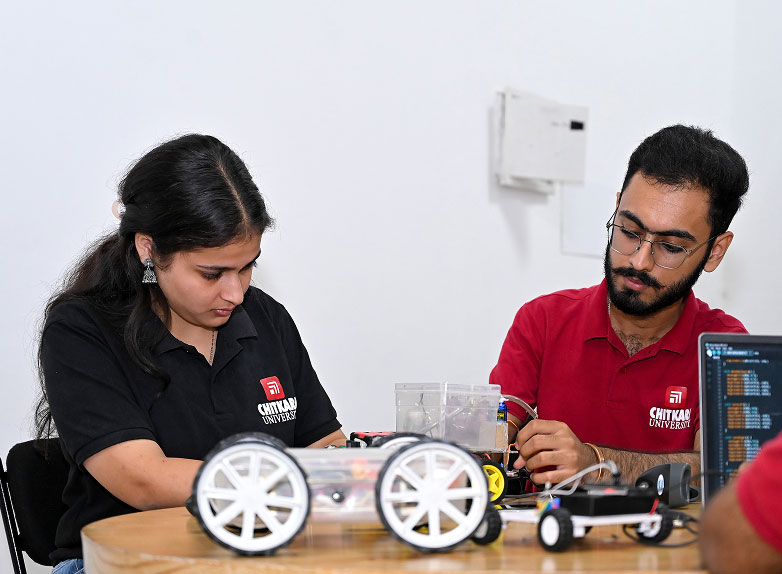
The Signal Processing Laboratory is a specialized facility that bridges the foundational theoretical concepts covered in Signals & Systems with the advanced, application-driven principles of Digital Signal Processing. It serves as a critical environment where abstract mathematical concepts are transformed into tangible, experiential learning. The lab is Equipped with software tools like MATLAB and Simulink (Academic Campus wide License), that allows students to implement, analyze, and visualize algorithms for signal filtering, transformation, and spectral analysis.
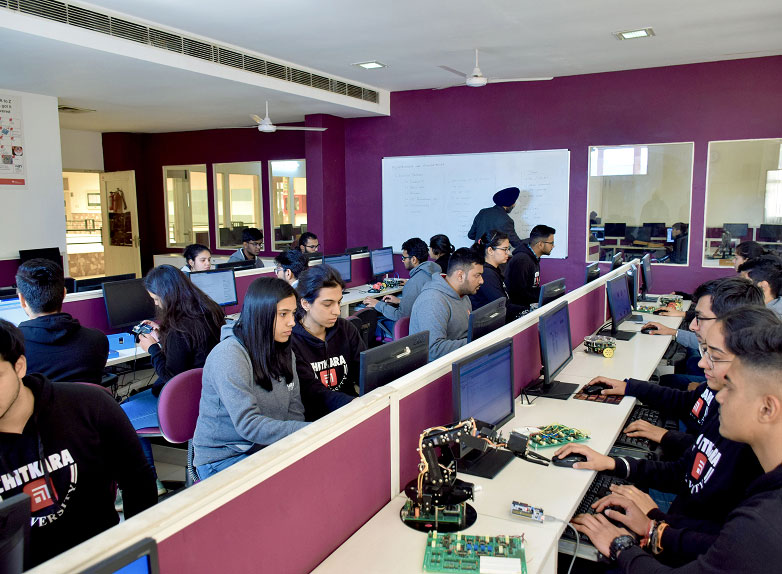
The Larva Laboratory constitutes a critical, foundational pedagogical environment within the Electronics and Communication Engineering (ECE) curriculum. It is purposefully designed to support the core instructional sequence encompassing Basic Electronics, Digital Electronics, and Capstone Project–I, thereby providing a continuous, hands-on learning pathway from introductory principles to integrative project-based application. The lab is equipped with digital logic design trainer kits, MCU’s and sensors, and a laser cutting machine for rapid prototyping. The lab enables students to design, assemble, and test basic electronic circuits and systems.
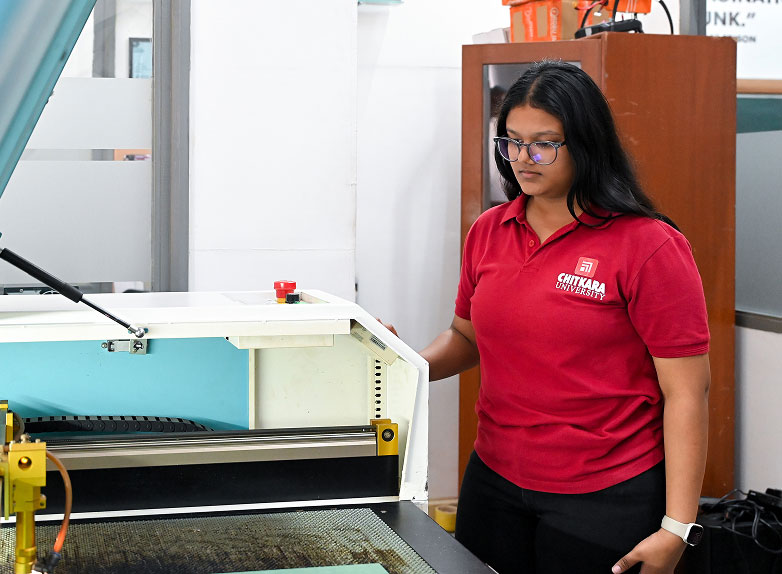
The Electronic Circuits Laboratory facilitates outcome-based learning for the Linear Integrated Circuits (LIC) and Analog Electronics courses. It provides a robust hands-on environment where students engage directly with core components, including operational amplifiers, timers, and various analog devices. By designing, constructing, and testing fundamental circuits—such as amplifiers, filters, and oscillators—using standard instrumentation (digital storage oscilloscopes, function generators, power supplies, and multimeters), students gain practical insight into core theoretical concepts and their real-world applications. The laboratory’s emphasis on experiential learning and application-oriented experimentation fosters design competency and practical proficiency, equipping students with skills directly relevant to real-world analog circuit design.
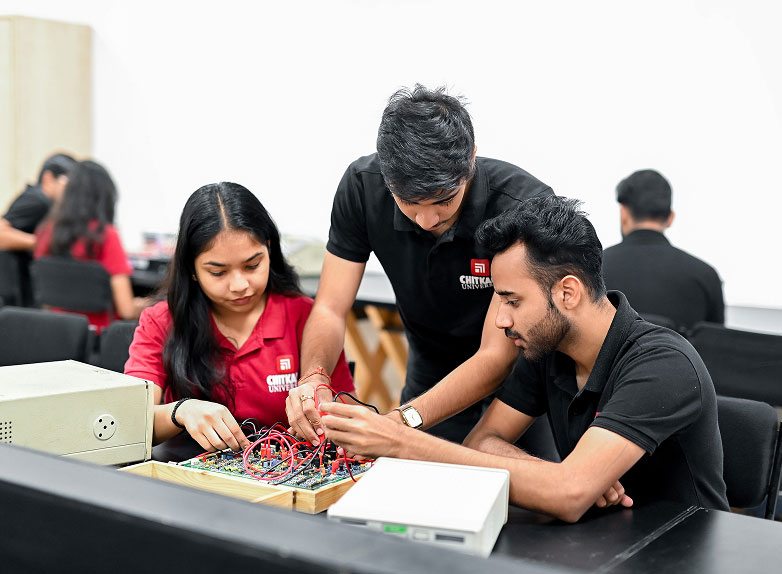
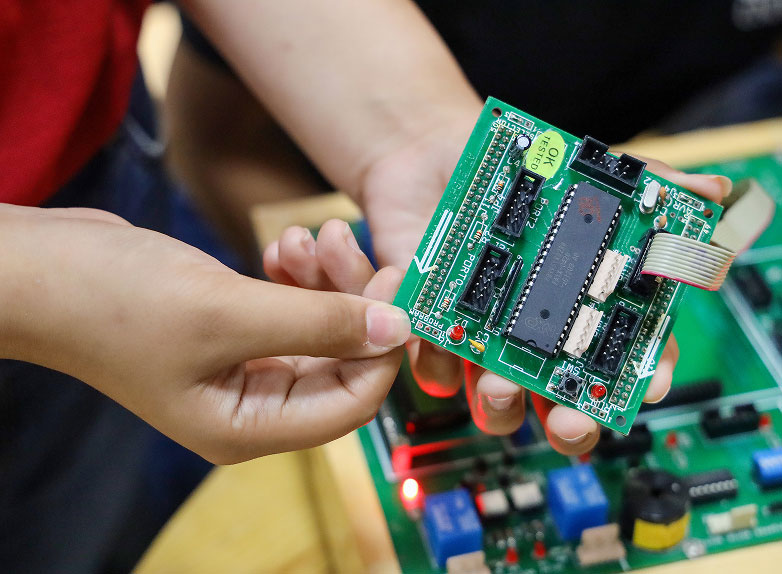
The Embedded System Design Laboratory is an advanced instructional facility that supports key courses in Microcontrollers, RTOS Development, and Embedded Linux. It provides a comprehensive, hands-on learning environment with diverse hardware platforms—including ARM, Arduino, and Raspberry Pi—and professional debugging tools logic analyzers. Through structured practical sessions, students develop proficiency in firmware development, real-time OS integration, and hardware-software co-design. Project-based learning enables them to synthesize these skills, designing and testing sophisticated embedded applications under real-world constraints. The laboratory thus prepares graduates for specialized roles in automotive, industrial automation, IoT, and consumer electronics sectors.
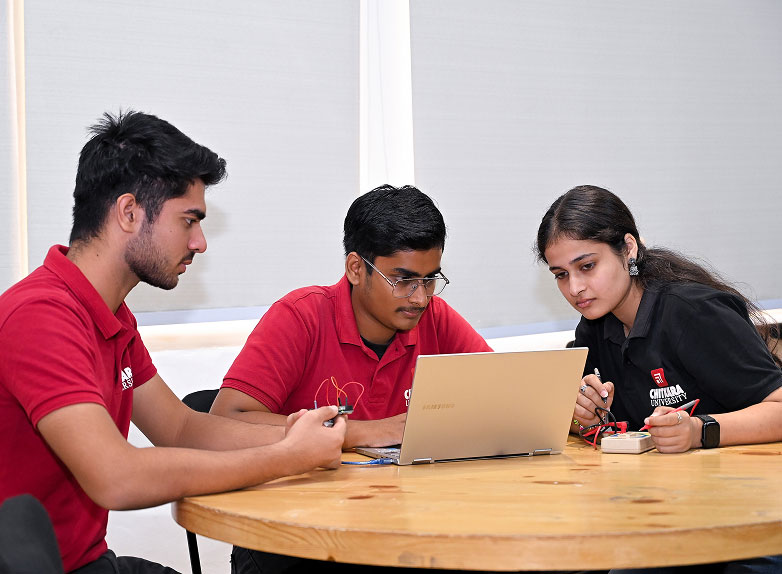
The Eureka Lab is a dedicated collaborative learning environment designed to foster innovation and experiential learning. It features a round-table layout and comprehensive computing resources to facilitate brainstorming, simulation, and project discussions. The facility supports team-based problem-solving, idea incubation, and prototype designing under direct faculty mentorship. A distinguishing strength is its integration of MS Office tools with open-source platforms, enabling seamless documentation, data analysis, presentation design, and collaborative work within a unified space. By emphasizing creativity, critical thinking, communication, and teamwork, the lab provides a versatile venue for student-driven projects and extracurricular events, thereby complementing and enhancing the formal academic curriculum.
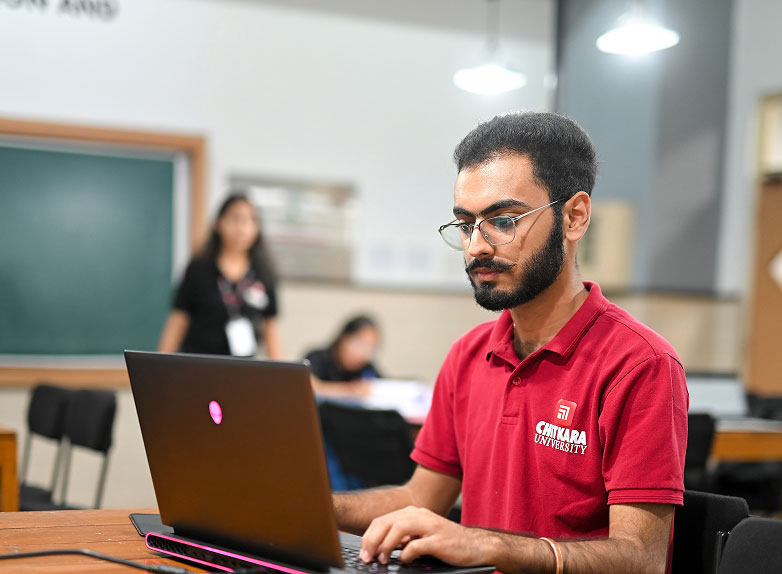
The Collaborative Learning Studio is a dedicated facility supporting programming courses, including Data Handling using Python and Object-Oriented Programming. It is designed to foster an active and team-based learning environment where peer collaboration is central. Through structured group projects, pair programming, and problem-solving sessions, students gain hands-on coding experience and engage in iterative algorithm development. This collaborative setting emphasizes logic building and critical thinking as students analyze problems and design effective solutions. The studio’s pedagogy cultivates not only technical proficiency but also essential workplace skills such as communication, teamwork, and systematic reasoning, preparing students for collaborative roles in software development and data-driven fields.



Chandigarh-Patiala National Highway, Punjab 140 401
Unit No. A 201-202, Elante Mall Office Complex
Industrial Area Phase 1, Chandigarh 160 002
Copyright © 2026 Chitkara Educational Trust
Unit No. A 201-202
Elante Mall Office Complex
Industrial Area Phase 1
Chandigarh 160 002
Chandigarh-Patiala National Highway
Punjab 140 401