Think about the last ten minutes of your day. You probably checked your phone, walked past a billboard, overheard a news channel, or scrolled past something a friend shared. None of that felt like a big moment. But every single one of those interactions was mass media doing exactly what it is designed to do putting information in front of a large number of people, almost without them noticing.
Most of us consume dozens of types of mass media every single day without ever stopping to name them. This guide changes that. By the time you finish reading, you’ll know exactly what mass media is, how the six types work, why they matter, and what a career in this world actually looks like.
What is Mass Communication?
Mass communication is the process of creating, sharing, and exchanging information through media channels to reach a wide and varied audience all at once.
Here’s the simplest way to understand it: when you text a friend, that’s interpersonal communication one person, one recipient, direct exchange. When a news channel broadcasts a story to millions of homes simultaneously, that’s mass communication. The difference is scale, reach, and the relationship between the sender and the audience.
Mass communication is characterised by:
- A single sender a broadcaster, newspaper, brand, or creator reaching many people at once.
- A large, often anonymous audience thousands to billions of people who may never interact with each other.
- Mediated channels the message travels through a platform or tool rather than direct personal contact.
- Delayed or limited feedback unlike a conversation, audience response is indirect and often aggregated.
The common tools of mass communication are:
| Tool | Medium Type | Example |
|---|---|---|
| Television | Broadcast | News channels, OTT platforms |
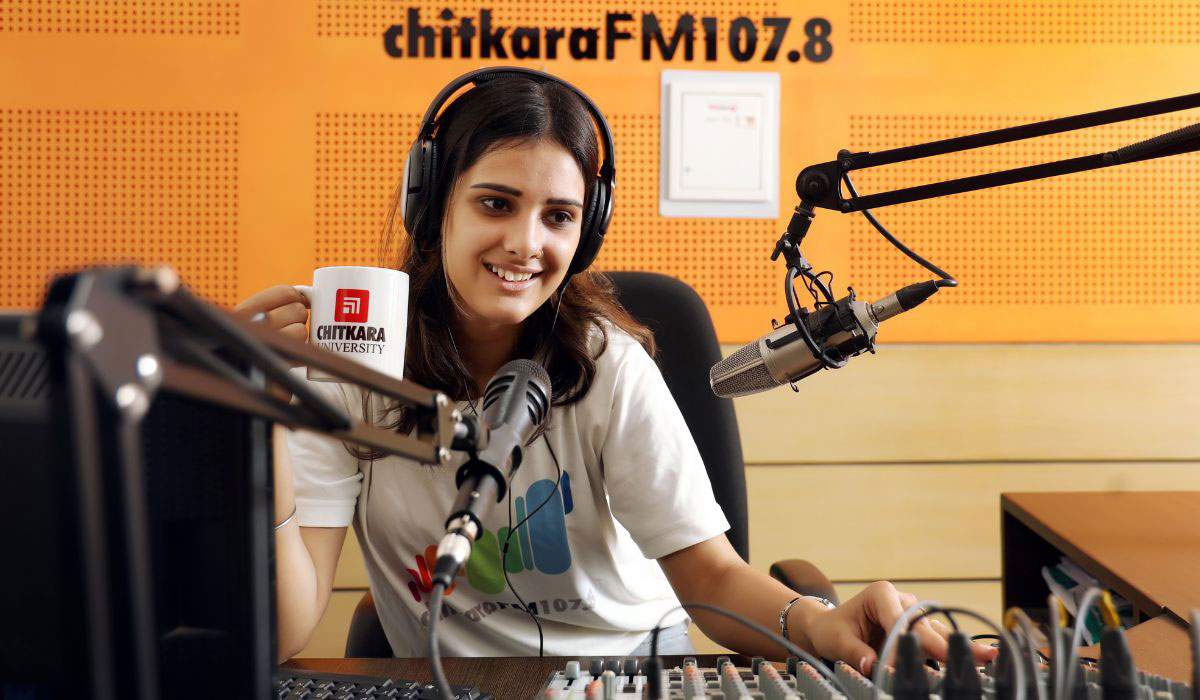
| Radio | Broadcast | FM stations, podcasts |
| Newspapers & Magazines | Times of India, National Geographic | |
| Social Media | Digital | Instagram, X (Twitter), YouTube |
| Films | Broadcast / Digital | Cinema, streaming platforms |
| Journalism | Print / Digital / Broadcast | Investigative reporting, online news |
| Advertising | All platforms | TV commercials, Google Ads, billboards |
| Public Relations | Print / Digital | Press releases, media campaigns |
| Photography | Print / Digital | Photojournalism, editorial imagery |
| Books & Journals | Print / Digital | Academic publishing, e‑books |
What is Mass Media?
Mass media refers to the communication channels and platforms specifically designed to reach a large, geographically dispersed audience at the same time.
There’s a subtle but important distinction worth getting clear on:
- Media is any tool used to transmit information from a handwritten letter to a smartphone notification. Broad by definition.
- Mass media is specifically the channels that communicate to large, diverse audiences simultaneously with limited direct interaction between the sender and the people receiving the message.
Mass media meaning in its simplest form: it’s the vehicle through which society receives news, entertainment, education, advertising, and cultural content at scale.
The story of mass media is really the story of human communication getting bigger and faster. It starts with the printing press in the 15th century, moves through the newspaper, the book, radio, and television, arrives at the internet and social media, and now continues with AI reshaping how content is created and distributed. Each leap changed not just how we communicate, but how we think, vote, shop, and see the world.
Today, mass media falls into six major categories each with its own tools, reach, strengths, and social impact.
Also Read: Chitkara’s Journalism & Mass Communication Program Integrates AI for Future-Ready Skills
Mass Media vs. Mass Communication: Key Differences
People often use these two terms interchangeably, but they describe different things. Here’s a clear breakdown:
| Aspect | Mass Media | Mass Communication |
|---|---|---|
| Definition | The tools or platforms used to deliver information to large audiences | The process of transmitting information and messages to large audiences |
| Focus | The medium TV, radio, newspapers, internet | The act of communicating creating and sending messages |
| Scope | Covers the six major media platforms | Includes verbal, written, visual, and non-verbal communication through media |
| Purpose | To serve as the channel for delivering content | To share ideas, information, and messages effectively |
| Examples | Newspapers, television, radio, social media | News broadcasting, advertising campaigns, public speeches |
| Key Component | The medium or platform itself | The message and the audience interaction |
| Dependency | Relies on communication to create and fill content | Relies on media platforms for transmission and reach |
| Nature | Technology and tool-centric | Process and interaction-centric |
Here’s the analogy that makes it click: mass media is the road. Mass communication is the journey that takes place on it. You need both for information to travel from where it starts to the people who need to receive it.
Importance of Mass Media in Society
Mass media matters because it performs six roles nothing else in society fully replaces: informing the public, building education and awareness, shaping culture and identity, powering commercial activity, holding power accountable, and providing entertainment and connection. Take any one away, and something in daily life stops working.
It’s easy to take mass media for granted it’s just always there. But step back and consider what life would look like without it. No way to know what’s happening in your city, your country, or the world. No shared cultural moments. No public accountability for people in power.
1. Informing the Public: For most people, mass media through newspapers, news broadcasts, and online journalism is how they learn about world events, government decisions, scientific developments, and what’s happening in their own communities. Without it, meaningful participation in democracy becomes nearly impossible. An informed citizenry depends on a functioning media ecosystem.
2. Education and Awareness: Mass media educates in ways that formal schooling can’t always reach. Documentaries explain history and science. Public service campaigns change behaviour around health, safety, and the environment. YouTube tutorials, podcasts, and online courses have put knowledge into the hands of people who would never have had access to it otherwise.
3. Shaping Culture and Identity: The films we watch, the music we hear, the stories we follow these don’t just reflect who we are, they actively shape who we become. Mass media both mirrors society and nudges it forward. The representation (or absence of representation) in media has real consequences for how people see themselves and others.
4. Commercial and Economic Function: India’s media and entertainment industry is one of the largest in the world and continues to grow year on year, driven by digital media, advertising, and live experiences (FICCI-EY). Brands, businesses, and governments all rely on mass media to reach their audiences through advertising, public relations, and campaigns. This creates enormous employment across production, distribution, technology, and marketing.
5. Political Influence and Accountability: A free press is called the fourth pillar of democracy for good reason. Mass media through investigative journalism holds governments, institutions, and corporations accountable in ways that no other mechanism can. When that function is weakened, the consequences for society are serious.
6. Entertainment and Social Connection: Films, streaming platforms, music, sports, and social media fulfil something deeply human the need to share stories, laugh together, grieve together, and feel part of something larger than our own immediate lives. That’s not a trivial function. It’s one of the things that holds communities together.
Read this blog post: Shaping Society Through Journalism.
For brands and organisations, mass media isn’t just a channel it’s the environment in which their reputation either grows or erodes. Using the right type of mass media for the right message is one of the most consequential decisions a communicator makes.
Functions of Mass Media – What Does Mass Media Actually Do?
Mass media performs four core functions in society: surveillance, keeping the public informed; correlation, interpreting what events mean; cultural transmission, passing on values to the next generation; and entertainment. Communication scholars identified these decades ago, and once you know them, you start noticing all four at work in everything mass media produces.
Beyond the obvious output news, entertainment, ads, culture there’s a deeper question worth asking: what role does mass media actually play in how society works?
1. Surveillance (Information Function): Mass media acts as society’s watchdog constantly scanning the environment for news, threats, opportunities, and developments the public needs to know about. Breaking news, weather alerts, stock market updates, investigative journalism that exposes wrongdoing this is the surveillance function at work. Without it, most people would have no way of knowing what’s happening beyond their immediate surroundings.
2. Correlation (Interpretation Function): Reporting facts is only part of the job. Mass media also contextualises and interprets helping audiences understand what events actually mean and how they connect to each other and to daily life. News analysis, editorial opinion, expert commentary, and documentary journalism all serve this function. It’s what separates information from understanding.
3. Cultural Transmission (Education Function): Every society has a set of values, norms, histories, and traditions it wants to pass on to the next generation. Mass media is one of the primary vehicles for that transmission. Films, television, literature, and music socialise new generations into their cultural context sometimes consciously, often not.
4. Entertainment Function: A significant portion of all mass media output is designed to do one thing: entertain. Streaming platforms, cinema, sports broadcasting, social content these give people relaxation, emotional engagement, humour, and escape. That’s not a lesser function. For many people, it’s the one they value most.
When brands and organisations understand these four functions, their communication decisions become sharper. Matching the right message to the right type of mass media and the right function is what separates campaigns that land from those that don’t.
6 Types of Mass Media – Complete Guide With Examples
There are six types of mass media. Each serves different audiences, communication purposes, and reach levels. And while digital technology is blurring the boundaries between several of them, understanding each type on its own terms still matters because each has distinct strengths that no other type can replicate.
1. Traditional Media
Before printing presses, radio towers, or smartphone screens there was traditional media. It’s the oldest form of mass communication, and it’s still very much alive.
Traditional media developed organically within communities, based on local culture, language, and social customs. It isn’t mediated by technology. It’s human beings communicating directly with other human beings through performance, storytelling, song, and ritual.
| Feature | Detail |
|---|---|
| Origin | Pre-industrial, community-based |
| Audience | Local / regional communities |
| Format | Oral and performative |
| Examples | Folk songs, dances, folklore, rural radio, community announcements, fairs and festivals, puppet theatre, street plays |
| Relevance Today | Still active in rural India and developing regions widely used for public health campaigns, governance communication, and grassroots awareness drives where digital access is limited |
Don’t underestimate it. In rural India and across many developing regions, traditional media remains the most trusted and accessible channel for reaching communities that digital and broadcast media simply don’t reach.
2. Print Media
Print media changed everything. When Johannes Gutenberg invented the printing press in the 15th century, he didn’t just create a new way to produce books he made it possible, for the first time in history, for a single message to reach thousands of people simultaneously. That was the birth of mass media as we know it.
| Feature | Detail |
|---|---|
| Format | Physical printed material |
| Reach | Local, national, and international |
| Examples | Newspapers, magazines, books, comics, academic journals, promotional brochures, newsletters |
| Strengths | High credibility, in-depth reporting, tangible and archivable |
| Challenges | Declining print circulation due to digital shift; higher production costs compared to digital formats |
Real-World Mass Media Examples – Print: Times of India, The Hindu, India Today, National Geographic, Vogue India, academic textbooks.
Print may have lost ground to digital in recent years, but it hasn’t lost credibility. For many audiences, a printed newspaper or magazine still carries an authority that a social media post can’t replicate.
3. Broadcast / Electronic Media
Radio arrived in the early 20th century and gave mass media its voice literally. For the first time, a single person could speak to millions simultaneously, in real time. Television added vision to that equation, and everything changed again. Broadcast media turned mass communication into a shared experience that entire nations could have together, at the same moment.
| Feature | Detail |
|---|---|
| Sub-types | Radio and Television |
| Reach | National and international simultaneous |
| Examples | FM radio, AM news radio, news TV channels, entertainment channels, sports broadcasts |
| Strengths | Reaches populations without reliable internet; real-time information delivery; high emotional impact |
| Challenges | One-way communication; limited audience targeting compared to digital |
Radio remains one of the most accessible types of mass media in rural and developing regions reaching audiences that have no reliable internet or television access. Its low cost of entry makes it irreplaceable for public communication in these contexts.
Television has evolved from a news and entertainment medium into a cultural force and now converges with digital through OTT platforms like Netflix, Amazon Prime Video, and Disney+ Hotstar. The screen is the same, but what’s on it and how audiences engage with it has changed completely.
4. Outdoor Media
Here’s what makes outdoor media genuinely unique among all types of mass media: it’s the only one you can’t turn off, block, skip, or unsubscribe from. It’s simply there on the highway, at the bus stop, above the intersection whether you’re looking for it or not.
| Feature | Detail |
|---|---|
| Format | Visual / static or digital display |
| Placement | Streets, highways, transit hubs, shopping areas |
| Examples | Billboards, hoardings, bus shelter ads, digital LED screens, kiosks, wall paintings |
| Strengths | High visibility; cannot be skipped or blocked; 24/7 exposure |
| Challenges | Cannot be targeted to specific audiences; limited message length |
Outdoor media is particularly effective for brand awareness and public service announcements. A single well-placed billboard in a high-traffic location can generate millions of impressions per month at a cost per impression that’s hard to beat.
5. Transit Media
Transit media is outdoor media’s more focused cousin specifically designed for the environments where people move through the world: buses, metro trains, airports, auto-rickshaws, and the stations and terminals that connect them.
What sets it apart is the audience. A commuter on a metro train has nowhere else to be for the next 20 minutes. That’s an unusually captive, attentive audience and transit media is built to take advantage of exactly that.
| Feature | Detail |
|---|---|
| Format | Display advertising on or inside vehicles and transit stations |
| Placement | Buses, metro trains, auto-rickshaws, airports, bus stations |
| Examples | Bus wrap advertising, metro station panels, taxi roof displays, airport terminal ads |
| Strengths | Captive audience during commute time; high repeat exposure for daily commuters |
| Challenges | Geographic limitation; cannot be personalised |
In India’s major cities Mumbai, Delhi, Bengaluru, and Chennai where millions of people commute daily by metro, bus, and auto, transit media gives advertisers consistent, repeated access to a large urban audience at remarkably low cost per impression.
6. Digital Media
Digital media is the newest of the six types of mass media and in a relatively short period of time, it has become the dominant one. It’s now where most people get their news, their entertainment, their shopping inspiration, and their sense of what’s happening in the world.
What makes digital media different from every other type isn’t just the scale or the speed. It’s the direction. Every other type of mass media sends information one way from a broadcaster, publisher, or advertiser to a passive audience. Digital media runs both ways. Audiences don’t just receive content. They respond to it, share it, argue about it, remix it, and create their own. That shift changed mass communication at a fundamental level.
| Feature | Detail |
|---|---|
| Format | Interactive, two-way, multimedia |
| Reach | Global instant and borderless |
| Examples | Social media (Instagram, YouTube, X), websites, blogs, podcasts, online news portals, email newsletters, OTT platforms |
| Strengths | Two-way interaction; highly targeted; real-time; multimedia; low entry barrier |
| Challenges | Information overload; misinformation spread; privacy concerns; algorithm-driven content bubbles |
India is one of the world’s largest and fastest-growing digital media markets, driven by affordable smartphones, expanding internet access, and strong appetite for regional-language content (FICCI-EY). Digital advertising now accounts for nearly two-thirds of total advertising revenues in the country a share that continues to grow each year as brands follow audiences to where they actually spend their time.
Career In Mass Communication
A career in mass communication puts you at the centre of how information reaches and shapes the public, spanning roles in journalism, broadcasting, advertising, PR, and digital content across every type of mass media covered in this guide.
If you’re drawn to the idea of shaping how people receive and understand information, this field puts you right at the centre of that process.
The field is broad by design. Mass media spans print, broadcast, digital, outdoor, and everything in between and so do the careers that come with it. Journalists, documentary filmmakers, advertising strategists, PR professionals, content creators, news anchors, social media managers, podcast producers, and media planners are all working within the same ecosystem, just at different points in the chain between message and audience.
India’s media and entertainment industry is among the largest in the world and continues to grow, with digital media as its fastest-moving segment (IBEF). The demand for skilled communicators who understand how different types of mass media work and how to use them strategically isn’t going away anytime soon.
Why Pursue B.A. In Journalism and Mass Communication?
India’s media industry thrives on strong content consumption across both metro and non-metro markets, driven by the rise of regional media, OTT platforms, and digital-first formats. The six types of mass media traditional, print, broadcast, outdoor, transit, and digital are all active, all hiring, and all evolving.
Read this blog post: Top 5 Career Opportunities for Journalists in India.
The B.A. in Journalism and Mass Communication with AI at Chitkara University is built on applied research integrated with the dynamics of communication and creative industries. It equips students with professional skills across print journalism, television and radio broadcast, and online multimedia while also preparing them for the AI-powered tools that are reshaping every corner of the media landscape.
For students who want to understand how mass media actually works not just in theory, but in practice and build a career at the intersection of storytelling, technology, and public communication, the Journalism and Mass Communication program at Chitkara University is a strong place to start.