Even if you fail to clear the cutoff marks in NEET, it doesn’t mean you can’t pursue a career in healthcare. Yes, we are talking about pharmaceutical sciences. A Bachelor of Pharmacy (B. Pharm) degree can be the ideal alternative to pursue an undergraduate degree in healthcare through an alternative route. The criteria for admission to various B. Pharm courses can be different. While some may require you to clear NEET, others may have a different set of criteria. For example, the current admission criteria for the B. Pharm course at Chitkara College of Pharmacy, Chitkara University, Punjab are Class XII with an aggregate of 50% in Physics, Chemistry and Biology/Mathematics. He/She has to appear for a personal interview.
Quick Answer: What Can You Do If You Miss the NEET Cutoff?
If you have tried to get into MBBS/medical after NEET, then you must understand that there is more to healthcare than just treating patients. One can also be involved in designing, developing and marketing medicines, clinical research, quality assurance, hospitals, health insurance, health management, health education and more!
As for being interested in medicines (pharmaceuticals), B. Pharm can be an alternate route for a career in healthcare (pharmaceuticals related) and research too.
A B. Pharm is generally a 4 year full time undergraduate degree program that covers all aspects of pharmaceutical sciences, including drug formulation and development, pharmacology, pharmaceutical chemistry, pharmacognosy, quality assurance etc. The Pharmacy Council of India recognises B. Pharm as a 4-year course after 10+2.
Why Consider B. Pharm After Missing NEET
NEET is a fundamental process for admission to almost all medical courses across the country, and looking at the larger picture of health care there is more to it than just treating a patient and thus being a doctor.
The pharmaceutical sector requires professionals who understand:
- Drug formulation and development
- Pharmaceutical chemistry
- Pharmacology
- Quality assurance and quality control
- Clinical research
- Regulatory affairs
- Drug safety
- Pharmaceutical manufacturing
- Healthcare and pharmaceutical marketing
- Research and development
B. Pharma graduation is a great way to enter the pharmaceutical and healthcare industry without pursuing an MBBS degree.
Please verify the eligibility criteria and the admission process for each University before applying. The criteria and process can vary from University to University and can change from year to year.
What Is a B. Pharm Degree
The Bachelor of Pharmacy degree, more commonly known as B. Pharm, is a four-year undergraduate degree that provides in depth understanding of the science and practice of pharmacy.
B. Pharm students learn how to make medicines and how they affect humans. They also get an insight into the analysis of medicines in the laboratory.
The core areas generally include:
- Pharmaceutics – drug formulation, dosage forms and drug delivery
- Pharmacology – how medicines interact with the body
- Pharmaceutical Chemistry – chemistry, synthesis and analysis of medicines
- Pharmacognosy – medicines and active compounds derived from natural sources
- Pharmaceutical Analysis – testing and analysing pharmaceutical products
- Clinical Pharmacy – application of pharmaceutical knowledge in healthcare settings
- Regulatory Affairs – understanding pharmaceutical regulations and compliance
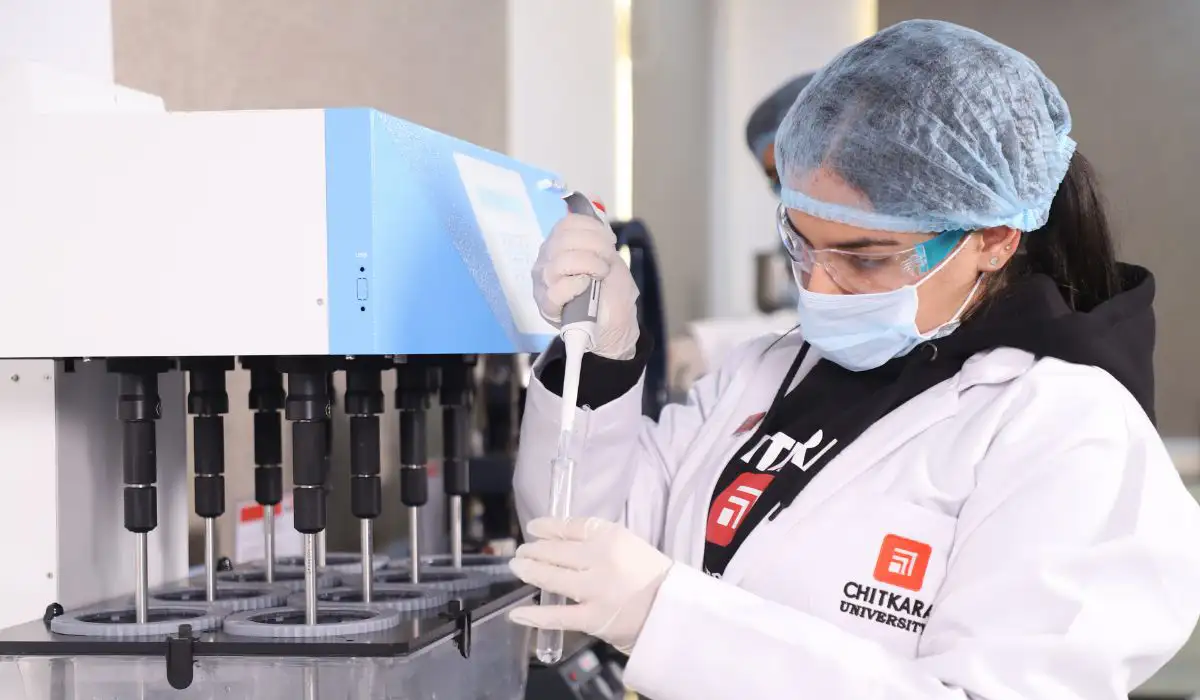
The B. Pharm program at Chitkara College of Pharmacy includes hands-on training in the classroom and makes students ready to apply their knowledge in actual Pharmaceutical and healthcare environments. They will get a chance of industrial training for 6 months as part of the University’s program.
What Will Students Learn During B. Pharm?
A good pharmacy program should be more than a series of classroom sessions, aiming to equip students with both scientific knowledge and practical and professional skills to face future challenges.
Core subjects and skills include
Pharmaceutical Sciences
Students gain in-depth knowledge in areas of Pharmaceutics, Pharmacology, Pharmaceutical Chemistry and Pharmacognosy.
Drug Formulation
How medicines are made into different forms (tablets, capsules, liquids, etc.) to deliver drugs to the body.
Laboratory Skills
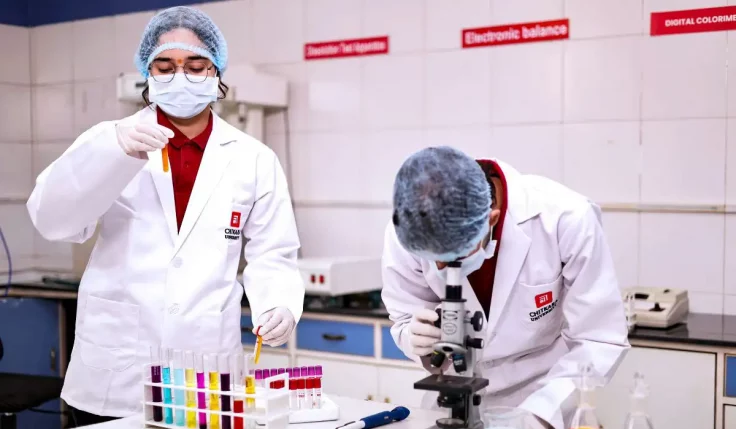
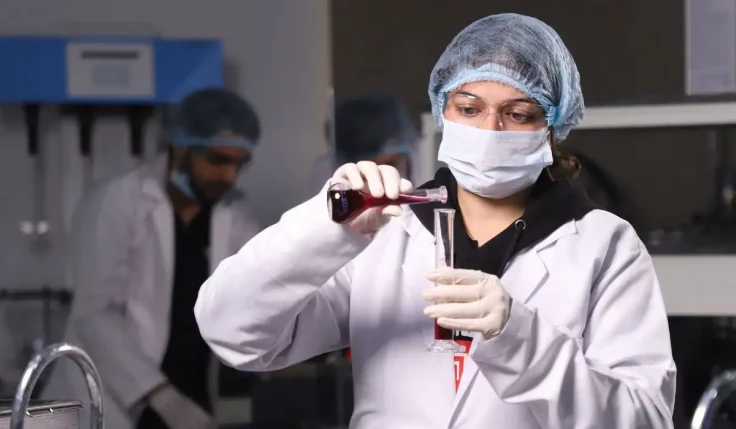
Practical laboratory work to teach students pharmaceutical analysis, pharmaceutical formulation and pharmaceutical quality testing.
Research Skills
The ability to analyse information, to complete experiments, and to interpret results from such experiments.
Quality Control and Quality Assurance
Ability to assess and implement Quality Control and Quality Assurance in order to ensure that pharmaceutical products meet a defined standard of safety, quality and consistency.
Communication and Professional Skills
These are in addition to the basic scientific knowledge of the pharmacist and are needed in today’s environment to communicate with patients, other health care professionals and industry.
Industry Exposure
Internships and industrial visits can also be integrated into the program to get students familiarise themselves with pharmaceutical companies, hospitals and research organisations and the way they function.
Career Opportunities After B. Pharm
One of the biggest advantages of B. Pharm is the range of career paths available after graduation.
Depending on their interests, skills and experience, graduates can explore opportunities in pharmaceutical companies, hospitals, research organisations, healthcare companies, regulatory bodies and other related sectors.
Some career options include:
| Career | Typical Work |
| Drug Analyst | Analysing pharmaceutical products and formulations |
| QA/QC Executive | Quality assurance and quality control |
| Manufacturing Executive | Pharmaceutical production and operations |
| Clinical Research Associate | Supporting and monitoring clinical trials |
| Regulatory Affairs Executive | Managing regulatory documentation and compliance |
| Drug Inspector | Regulatory inspection and compliance |
| Medical Writer | Preparing scientific and medical content |
| Hospital Pharmacist | Supporting medication management in healthcare settings |
| Pharmaceutical Sales & Marketing | Product promotion and market development |
| Research Associate | Pharmaceutical and scientific research |
Chitkara’s recent pharmacy guidance also identifies roles including Drug Analyst, Manufacturing Executive, QA/QC Executive, Clinical Research Associate, Regulatory Affairs Manager, Drug Inspector and Market Development Executive.
B. Pharm Salary in India
Salary depends on several factors, including job role, location, employer, skills, academic background and experience.
According to Chitkara University’s 2026 pharmacy career guidance, entry-level B. Pharm graduates can expect around ₹4–6 lakh per annum on average, although individual packages can vary significantly.
Rather than focusing only on the first salary package, students should consider opportunities for long-term growth through specialisation, experience, higher education and industry certifications.
B. Pharm vs MBBS: Which Is Right for You?
Missing the NEET cutoff may lead students to compare B. Pharm with MBBS. However, these are fundamentally different professional pathways.
| Factor | MBBS | B. Pharm |
| Primary focus | Medicine and patient care | Medicines and pharmaceutical sciences |
| Duration | Generally longer | 4 years |
| Career direction | Doctor/medical practitioner pathway | Pharmaceutical and healthcare careers |
| Core learning | Anatomy, physiology, medicine, surgery and clinical sciences | Pharmaceutics, pharmacology, pharmaceutical chemistry and pharmacognosy |
| Industry opportunities | Hospitals, clinics and healthcare | Pharma, research, manufacturing, QA/QC, regulatory and healthcare |
| Research opportunities | Medical and clinical research | Drug development, pharmaceutical research and clinical research |
| Admission | NEET-based medical admission pathways | Varies by institution and programme |
The key point is that B. Pharm should not be viewed simply as a substitute for MBBS. It is a professional degree with its own career opportunities and areas of expertise.
Why Consider Chitkara College of Pharmacy in Punjab?
Top Pharmacy Colleges in Punjab – A Guide. At the start of your search for Top Pharmacy Colleges in Punjab, it is important to look beyond the advertisements and promotional literature of pharmacy colleges and understand the essential criteria on which you should decide. For example – Is the pharmacy college in Punjab is for PCI approval? What is Pharmacy College Ranking in Punjab? What is the curriculum? What are the research facilities? What are practical & industrial Training? What are the profiles of Faculty Members? What is the industry exposure of a pharmacy college in Punjab? What are the internship opportunities? What are Career Opportunities?
Chitkara College of Pharmacy is another institute which has been described in terms of parameters for evaluation.
The College is offering B. Pharm and postgraduate & doctoral programs in Pharmaceutical Sciences. Chitkara University’s pharmacy program information clearly depicts practical learning, industrial exposure and a research-oriented curriculum.
Some factors students can evaluate include:
- PCI recognition and academic credibility
- Chitkara’s B. Pharm program is approved by the Pharmacy Council of India (PCI).
- National ranking
- Chitkara University stands at 16th position in the rankings of pharmacy schools published by NIRF in 2025.
- Practical learning: The B. Pharm program has lab work and 6 months of industrial training as a part of the course structure, which helps students to gain practical knowledge and makes them industry-ready.
- Industry exposure: The university positions itself to provide a connection between pharmaceutical education and industry requirements by fostering industry relationships, training and placing students for internship programs.
- Research environment: The pharmacy college has full facilities for research in all areas of pharmaceutical sciences and has well-equipped laboratories and research centres.
Future Scope of Pharmacy
Pharmacy has moved on from the traditional role of dispensing medicines.
The sector is rapidly evolving and is today linked to many factors such as biotechnology, digital healthcare, data analytics, personalised medicine and new products in development.
Emerging areas include:
- Clinical Research
- Pharmacovigilance
- Drug Discovery
- Biotechnology
- Regulatory Affairs
- Medical Devices
- Digital Healthcare
- Healthcare Data and Analytics
- Personalised Medicine
- Pharmaceutical Manufacturing
- Quality Assurance and Quality Control
Technology is increasingly playing a bigger role in health and the way health professionals work, including pharmacy. Examples include telepharmacy and the use of electronic health tools, including electronic health records, and health data and analytics, including pharmacogenomics.
There are many new opportunities for those with a mix of traditional pharmaceutical knowledge and up-to-date digital and analytical skills.
How to Choose the Best Pharmacy College in Punjab
Do not select a B. Pharm college on the basis of location/advertising only.
Consider these factors:
Accreditation and Recognition
Check if the program has the necessary statutory approval and recognition to operate as a B. Pharm program.
Curriculum
The course structure should provide a combination of Pharmaceutical Sciences and Practical/Industry Oriented approach.
Laboratories
These are practical subjects, and hence the college must have adequate lab space and good facilities for carrying out research.
Faculty
Check faculty qualifications, research activity and industry experience.
Industrial Training
A planned internship or industrial training period can be very useful.
Placement Support
Look at the sorts of organisations that your graduating class is being placed with and the sorts of jobs that they are being placed into.
Research Opportunities
Research projects are excellent for students who are looking to join M. Pharm courses, clinical research jobs, PhD programs and R&D roles.
National Rankings
Take note of National Rankings (e.g. NIRF) but do consider other factors like course content, infrastructure & graduate destiny.
Conclusion: Missing NEET Doesn’t Mean the End of Your Healthcare Career
It is very possible to achieve your goals in healthcare, even if you don’t meet the cut off for NEET.
If your interest lies in medicines, pharmaceutical research, drug development, healthcare, clinical research or the pharmaceutical industry, then B. Pharm is a structured professional program that can lead to great careers in these areas.
When looking for the best pharmacy college in Punjab, it is best to look at how an institution is recognised, ranked, the curriculum it follows, hands-on training it provides to students, research that it supports, industry links and overall support the college gives to its alumni. Chitkara College of Pharmacy is one such institution which is recognised for its B. Pharm program, which is a 4 year program approved by PCI and ranked 16th in the NIRF 2025 Pharmacy rankings.
Your NEET score may influence one career option but not your whole life in healthcare.
Chitkara College of Pharmacy: Shaping Future-Ready Pharmacy Professionals
Chitkara College of Pharmacy, established in 2005 with the aim of catering to educational and research needs in the field of pharmaceutical education, is offering Four years B. Pharm, Master’s degree in M. Pharm, Doctoral degree in the form of Pharm. D and Pharm. D (Post-Baccalaureate) and a Master’s degree in Pharmacovigilance. All the programs are being conducted with the vision of providing the best pharmaceutical education along with practical training and innovative methods of education, with industrial exposure to make the students competent to meet the requirements of the pharmaceutical industry and health care systems. The college has well-qualified and experienced faculty and all necessary facilities to impart quality of education in the field of pharmaceutical sciences. The college is also engaged in research activities and students are exposed to all aspects of pharmaceuticals like drug discovery, drug development, patient care, etc.
Industry interaction, research, innovation and practical learning are the hallmarks of learning at Chitkara College of Pharmacy. The College engages in active collaborative research with institutions across India. The future ready students and researchers of CCP would contribute to developments in health care and to drug discovery and development while ensuring patient safety and optimising use of existing drugs. A strong alumni base of the college is spread across India and abroad and provides opportunities for mentorship, networking and guidance to students for placement in industry, research organisations and other healthcare establishments.
All programs at CCP are designed to create future pharmacy leaders and equip students with the best academic and practical knowledge to face the challenges of the fast evolving pharmaceutical sector. As a leading pharmacy college in Punjab, it continues to ascend the ranks of pharmacy education nationally. As per NIRF 2025 rankings published by Ministry of HRD, CCP is ranked 16th in the Pharmacy category nationally. Its strong industry connected programs and best in class employability has ensured that its students are placed in the best pharmaceutical companies, top hospitals, community pharmacy chains, research institutions and other healthcare institutions across the country. It is offering programs at undergraduate, postgraduate and doctoral levels including specialised area of pharmacovigilance. Thus, it is an ideal place for students who are seeking quality pharmacy education, which not only provides them with in-depth knowledge of pharmaceuticals but also Hands-on-experiences, Research exposure and Industry connect.