
Introduction
Our way of manufacturing is changing. It is changingto very smart, very connected and very technological. It involves automation, artificial intelligence, robotics and data analytics forname. It willgenerate lot of jobs for skilled mechanical engineers to work in advanced manufacturing engineering jobs which willinvolve lot of traditional mechanical engineering along with new technology. This article is to make readers aware about smart manufacturing in detail. It will also helpstudent of mechanical engineering to identify right jobs in manufacturing and Industry 4.0 careers in India.
Quick Answer: What Are Smart Manufacturing Careers?
Smart Manufacturing or Industry 4.0 is about designing, managing and optimizing manufacturing in a fully automated way, supported by advanced components such as robotics, Industrial Internet of Things (IIoT), AI and analytics to create a totally technology-enabled smart manufacturing plant. It supports increasing productivity, efficiency and quality of the manufacturing process of any company.
The Smart Manufacturing careers belong to the Industry 4.0 era and Smart Manufacturing is interlinked and integrated with all production plants and intelligent technologies to increase production, efficiency and quality. All these production related activities and processes can be designed, developed and managed by a Mechanical Engineer.
Overview: Understanding Smart Manufacturing and Industry 4.0
Industry 4.0 refers to the fourth industrial revolution, characterized by the integration of digital technologies into manufacturing processes. Unlike traditional manufacturing systems, smart factories use interconnected machines, sensors, cloud computing, and real-time data analysis to improve operations.
Some of the key technologies driving smart manufacturing include:
- Artificial Intelligence (AI)
- Robotics and Automation
- Industrial Internet of Things (IIoT)
- Digital Twins
- Machine Learning
- Cloud Computing
- Cyber-Physical Systems
- Predictive Analytics
- Advanced Manufacturing Technologies
India’s manufacturing sector is rapidly embracing these innovations through initiatives such as Make in India, Digital India, and Production Linked Incentive (PLI) schemes. As a result, the demand for professionals with expertise in smart manufacturing is increasing across industries.
Skills, Subjects, and What Students Learn
Students pursuing mechanical engineering with a focus on smart manufacturing typically develop a blend of engineering and digital skills.
Core Technical Subjects
- Manufacturing Processes
- Industrial Engineering
- Machine Design
- Thermodynamics
- Fluid Mechanics
- Production Planning and Control
- Computer-Aided Design (CAD)
- Computer-Aided Manufacturing (CAM)
Industry 4.0 Skills
- Robotics Programming
- Automation Systems
- PLC Programming
- Industrial IoT Applications
- Data Analytics
- Artificial Intelligence Fundamentals
- Digital Twin Technology
- Smart Factory Operations
- Quality Control Systems
- Supply Chain Optimization
Soft Skills
- Problem Solving
- Critical Thinking
- Project Management
- Team Collaboration
- Innovation and Design Thinking
These skills help students become industry-ready and prepare them for advanced manufacturing engineering jobs.
Career Opportunities in Smart Manufacturing
The rise of Industry 4.0 has created diverse career opportunities for mechanical engineers.
Automation Engineer
Design & Maintenance of Automated Manufacturing Systems. Improve productivity by reducing manual intervention in processes.
Average Salary: ₹5–10 LPA (Entry to Mid-Level)
Robotics Engineer
Robotics Engineer- Robotics engineers design and develop robotic systems to be deployed in various industries like Automotive, Electronics and other Industrial Manufacturing units.
Average Salary: ₹6–12 LPA
Manufacturing Engineer
They improve existing production processes and, using smart manufacturing, they also develop new ones.
Average Salary: ₹5–9 LPA
Industrial IoT Specialist
Industrial IoT Specialists are responsible for connecting machines as well as systems through sensors and various networks. Their role involves to monitor as well as process large amounts of data in real time and take right decisions on time.Average Salary: ₹7–15 LPA
Smart Factory Engineer
Smart Factory Engineer: A smart factory engineer manages a digitalized and integrated production environment and monitors the smooth communication of all systems.
Average Salary: ₹8–16 LPA
Quality Systems Engineer
Quality engineers at PES University design and implement a quality system that can monitor product quality and also the manufacturing process using data and automation.
Average Salary: ₹5–10 LPA
Digital Twin Engineer
They create a virtual model or a ‘digital twin’ of the physical system which can be simulated in order to increase performance.
Average Salary: ₹8–18 LPA
Production Manager
They will manage to run manufacturing plants of large organizations and implement smart manufacturing to increase efficiency of production.
Average Salary: ₹10–20 LPA
Comparison: Traditional Manufacturing vs Smart Manufacturing Careers
| Factor | Traditional Manufacturing | Smart Manufacturing |
| Technology Usage | Limited Automation | AI, IoT, Robotics |
| Data Utilization | Manual Monitoring | Real-Time Analytics |
| Skill Requirements | Core Mechanical Skills | Mechanical + Digital Skills |
| Productivity | Moderate | High |
| Career Growth | Stable | Rapidly Expanding |
| Salary Potential | Moderate | Higher Due to Specialized Skills |
| Industry Demand | Consistent | Growing Significantly |
For students aiming for future-focused careers, smart manufacturing offers stronger growth prospects and access to cutting-edge technologies.
Future Scope of Industry 4.0 Careers in India
The future of Industry 4.0 careers India looks extremely promising. Several factors are driving demand for skilled professionals:
Growing Manufacturing Investments
India is emerging as a global manufacturing destination, attracting investments in automotive, electronics, aerospace, and renewable energy sectors.
Expansion of Smart Factories
Organizations are increasingly adopting automated production systems and connected manufacturing technologies.
Demand for Skilled Engineers
Companies require engineers who can manage advanced technologies while maintaining operational efficiency.
Government Initiatives
Programs such as Make in India, Digital India, and Skill India continue to support industrial growth and technology adoption.
Emerging Technologies
New opportunities are being created in:
- AI-powered manufacturing
- Autonomous robotics
- Additive manufacturing (3D printing)
- Industrial cybersecurity
- Sustainable manufacturing
Industry experts predict that smart manufacturing will generate thousands of new manufacturing engineering jobs over the next decade.
Best Universities and Programs for Smart Manufacturing Careers
Several universities and institutions offer mechanical engineering programs that include exposure to Industry 4.0 technologies and smart manufacturing concepts.
Some notable options include:
- Indian Institutes of Technology (IITs)
- National Institutes of Technology (NITs)
- Chitkara University
Students should look for programs that offer practical exposure to automation, robotics, AI, IoT, and advanced manufacturing systems.
Also, read this blog post: How B.Tech Mechanical Engineering is Powering the Evolution of Electric Vehicles
Conclusion
Smart manufacturing is transforming the way of doing business across geographies. It is exciting times for Mechanical Engineers as there is growing demand for manufacturing engineering jobs which are directly related to growth in Industry 4.0 careers India. Smart manufacturing technologies and the advanced manufacturing techniques and tools being adopted globally would form the core of study to equip students and make them industry ready.
Knowing the smart manufacturing concepts and the relevant Industry 4.0 tools would enable our students to have an edge while competing for the best manufacturing jobs of the future.
4-Year B.E. in Mechanical Engineering
Build a Strong Foundation for Future Engineering Careers
4-Year B.E. in Mechanical Engineering program at Chitkara University is designed to create Mechanical Engineers, who can design, design, develop and improve the mechanical systems and help organizations to achieve their goals. This program focuses on different areas of Mechanical Engineering. It involves understanding of thermodynamic systems, manufacturing of components, designing of mechanical parts, heat transfer and dynamics using CAD etc. The program is designed in such a way to create analytical abilities of studentswith practical approach to solve problems.
Industry-Focused Learning
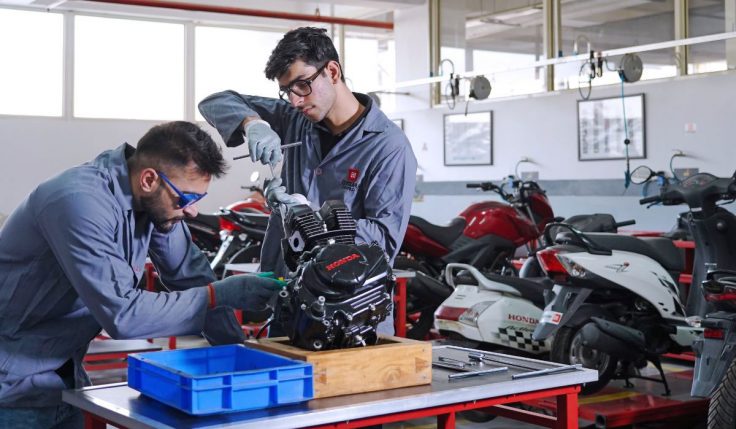
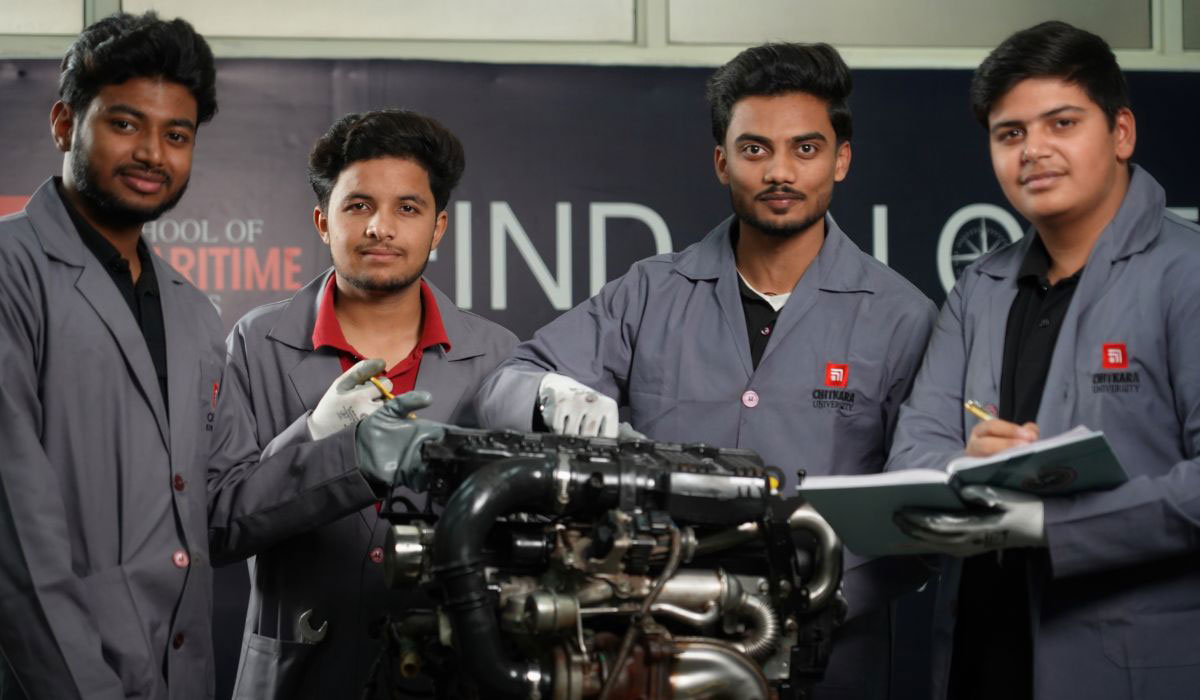
The curriculum supports the Industry Focus area by ensuring that students acquire sufficient knowledge and practical skills required to design and develop mechanical systems. Through numerous laboratories, workshops, industrial projects and industrial training the university provides hands-on experience required by today’s industry. Students can also specialize in Automobile Engineering, Robotics as well as Minor in Computer Science Engineering (CSE) to get placed in core as well as technology industry.
Career Opportunities and Recruiters
The 4 Year B.E. in Mechanical Engineering at Chitkara University helps to develop skills and knowledge to design and improve mechanical systems. A student learns subjects such as principles of thermodynamics, manufacturing, machine design, heat transfer, and dynamics. A student can also learn computer-aided designs for various mechanical systems using software such as Pro-E Wildfire 2.5, SolidWorks 2009, etc. The student develops analytical skills and knowledge by practical approach to education. Industry focused areas of learning are advanced mechanical laboratories, mechanical workshops, mechanical projects, and industrial training with organizations such as Tata Motors, Mahindra & Mahindra, Maruti Udyog, Bosch, JCB, L&T, Siemens, Schneider Electric, Cummins, Infosys, etc.