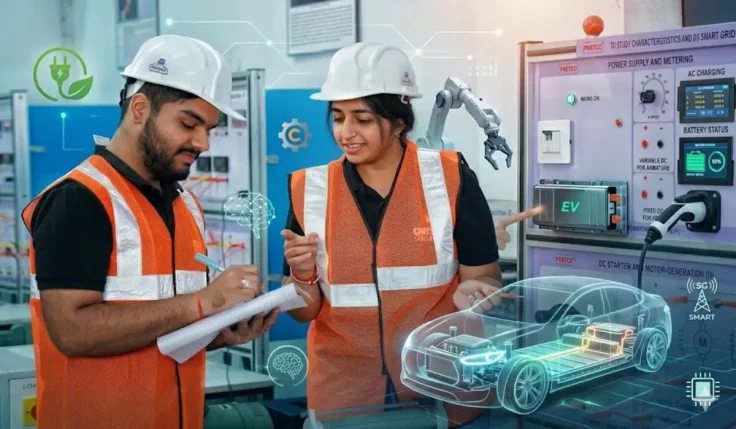

B.Tech Automobile Engineering is a future-focused engineering discipline that shapes next-generation mobility and transportation systems worldwide. The B.Tech Automobile Engineering program prepares students to design, develop, test, and improve vehicles—ranging from conventional automobiles to electric vehicles (EVs), hybrid systems, connected cars, and autonomous technologies. With rapid innovation and strong sustainability goals driving the automotive industry, B.Tech Automobile Engineering now extends beyond traditional engine design into EV powertrains, battery management systems, automotive software, advanced safety systems, and intelligent transportation technologies.
What is Automobile Engineering?
Automobile Engineering represents a specific engineering discipline which focuses on vehicle development from design through manufacturing and testing and maintenance of cars and trucks and buses and motorcycles and off-road vehicles. The system unites different engineering fields which include mechanical engineering together with electrical engineering and electronics and software engineering and materials science. Students pursuing automobile engineering courses learn about vehicle dynamics, internal combustion engines, powertrains, transmission systems, braking systems, aerodynamics, and safety engineering, along with emerging technologies such as electric vehicles (EVs) and autonomous driving.
A B.Tech Automobile Engineering program focuses on building both theoretical knowledge and practical skills. Students develop practical skills through their participation in laboratory work and workshop activities and their completion of industry-based projects and internships which ready them for worldwide automotive industry work.
Is Automobile Engineering a good career in 2026?
Yes. With EVs, hybrids, connected vehicles, and autonomy scaling fast, Automobile Engineering offers strong demand across R&D, testing, manufacturing, software, and EV infrastructure—especially in India and global markets.
Automobile Engineering Courses & Eligibility
There are several automobile engineering courses available at undergraduate, postgraduate, and diploma levels. The most popular option is B.Tech Automobile Engineering, typically a four-year undergraduate program. Students must finish Class XII with Physics and Chemistry and Mathematics as their main subjects and pass university entrance exams which most institutions require for admission.
Students at the postgraduate level have access to M.Tech programs and specialized automotive design and EV technology and automotive electronics programs. The automotive industry welcomes students who want to enter through technical roles by accepting their applications for Diploma programs. The educational programs at these institutions follow industry standards and maintain their relevance to current technological developments.
Career Opportunities in Automobile Engineering
The field of Automobile Engineering provides employees with multiple career paths which exist between manufacturing facilities and research centers and design studios and service organizations. Graduates of B.Tech Automobile Engineering can work as automobile design engineers, production engineers, quality assurance engineers, testing engineers, and maintenance engineers. They are employed by automobile manufacturers, component suppliers, research and development centers, motorsport companies, and government organizations.
The growing popularity of electric and connected vehicles has created new positions which focus on EV powertrain design and battery management systems and automotive software development and autonomous vehicle technology. Automobile engineers can find work in related fields which include logistics operations and transportation system development and defense industry work and aerospace engineering.
Who should choose B.Tech Automobile Engineering?
- Students interested in EVs, hybrids, and mobility tech
- Those who enjoy mechanics + electronics + software
- Learners aiming for R&D, testing, homologation, or manufacturing
- Candidates seeking global auto-industry exposure
Emerging Trends in Automobile Engineering
The automotive industry has started a fundamental change which has increased the importance of Automobile Engineering as a field. The market now focuses on electric vehicles (EVs) as its main direction because environmental sustainability initiatives and official government regulations have emerged. The current focus of engineers involves battery technology development together with charging system establishment and energy consumption optimization.
The market shows two major trends which include autonomous and connected vehicles that depend on software together with sensors and artificial intelligence and data analytics systems. The development of vehicle design and production occurs through the combination of lightweight materials with 3D printing technology and advanced manufacturing methods and smart safety system implementations. The current market trends have reshaped automobile engineering education through new course designs which focus on teaching students to develop skills for working across different fields and creating solutions for future transportation systems.
B.Tech Automobile Engineering vs Mechanical vs Electrical (EV Era)
| Factor | Automobile Engineering | Mechanical Engineering | Electrical Engineering |
| Core Focus | Vehicles, EV/HEV, powertrain, testing | Machines, thermals, design |
Power, electronics, control
|
| EV/Hybrid Exposure | Very High | Medium | High |
| Software + Sensors | High (ADAS, autonomy) | Low–Medium | Medium–High |
| Typical Roles | EV design, homologation, R&D | Manufacturing, design |
BMS, motors, power electronics
|
| Global Auto Demand | Very High | High | High |
| Best For | Mobility-focused engineers | Broad mechanical roles | Power & electronics roles |
Why Choose Automobile Engineering as a Career?
The field of Automobile Engineering allows me to work in an industry which unites technological advancement with creative product design and operational functionality. The field offers employees access to international career opportunities and competitive compensation and continuous learning possibilities because of its quick technological development. Students who want to work with vehicles and engineering design and sustainable mobility systems should pursue B.Tech Automobile Engineering because this program gives them essential knowledge to create a successful career path.
Real-World Outcomes for Automobile Engineering Graduates
-
EV powertrain & BMS roles at OEMs and EV startups
-
Testing & homologation engineers at R&D centers
-
Internships converting to PPOs in manufacturing & QA
-
Projects on battery packs, charging systems, ADAS prototypes
The Road Ahead
The field of Automobile Engineering will continue to lead the development of advanced transportation systems which will become more intelligent and environmentally friendly and secure. The worldwide need for automobile engineers will increase because of recent developments in electric vehicles and self-driving systems and digital transportation solutions. Students who select suitable automobile engineering programs will develop into innovative leaders who will direct the automotive industry toward its future direction.
Also, read this blog post: Future Scope of Automobile Engineering: What You Must Know
Chitkara University’s 4-Year B.E. in Automobile Engineering (EV & HEV) program focuses on developing students who will lead the evolution of transportation systems.
The automobile industry across the world needs to adopt sustainable mobility solutions because Automobile Engineering undergoes rapid transformation. Recognising this shift and the Government of India’s strong push toward Electric Vehicles (EVs) and Hybrid Electric Vehicles (HEVs), Chitkara University has partnered with the Automotive Research Association of India (ARAI) to offer a future-focused 4-Year B.E. in Automobile Engineering with specialisation in EV and HEV. The program follows a strategic plan which trains students to become industry-ready engineers who will create and validate and approve and develop future automotive technologies which will lead market leadership during the upcoming decades.
The program uses an original educational approach which unites academic studies with detailed hands-on training. Students spend 2.5 years on the Chitkara University campus building strong foundations in automobile engineering, EV and HEV fundamentals, vehicle systems, and both mechanical and electrical aspects of vehicle design. This is followed by 1.5 years at ARAI Academy, Pune, one of India’s most respected automotive R&D and certification institutions. Students dedicate their last year to complete a one-year project at either an industry or ARAI-based facility which enables them to tackle actual automotive problems through research and testing and development activities.
What truly sets this program apart is the collaboration with ARAI, the apex automotive R&D organisation established by the Government of India and the automotive industry. The organization ARAI conducts essential work for vehicle testing and homologation and certification and standardization and policy development according to the Central Motor Vehicles Rules. The partnership provides students with access to modern research facilities and certification programs and state-of-the-art automotive testing facilities. The curriculum includes lectures and tutorials and workshops and group projects and independent study which focus on project-based learning to help students develop skills like real industry professionals do through their “study less and work more” approach.
The specialized B.E. in Automobile Engineering program provides graduates with outstanding career opportunities because the world experiences fast growth of electric vehicles and hybrid electric vehicles and environmentally friendly transportation systems throughout India and worldwide. Graduates can pursue roles such as EV & Hybrid Design Engineer, Vehicle Testing and Homologation Engineer, Battery Design Engineer, Automotive R&D Engineer, Manufacturing Engineer, Automotive Safety Engineer, and EV Infrastructure Specialist, among others. The program provides students with access to internship and campus recruitment opportunities which enable them to join top global automobile companies across different sectors including design and manufacturing and research and testing and after-sales services. The EV- and HEV-focused Automobile Engineering program at Chitkara University provides students who love automobiles and sustainability and innovation with an excellent opportunity to become leaders in the developing mobility sector.
FAQs – B.E. in Automobile Engineering (EV & HEV) at Chitkara University
Foundations + EV/HEV modules, followed by industry-grade training and a capstone project tackling real automotive problems.
EV/Hybrid Design Engineer, Vehicle Testing & Homologation Engineer, Battery Engineer, Automotive R&D Engineer, Manufacturing Engineer, Safety Engineer, EV Infrastructure Specialist.