Introduction
B.Sc Optometry is a primary eye care speciality that deals with all vision-related problems, including eye & general health problems of patients. B.Sc Optometry graduates practice as primary eye care providers as Optometrists and work independently. B.Sc Optometry degree is a 3-year science degree and is followed by an internship for hands-on experience. However, the Bachelor of Optometry (B.Optom) degree is a professional degree now termed a standard degree for optometry by India’s National Commission for Allied and Healthcare Professions (NCAHP). The degree has a longer study period and includes a compulsory 1-year clinical internship. So, if one wants to practice as a registered optometrist, then one should opt for an NCAHP-aligned Bachelor of Optometry degree. In this article, we compare B.Sc Optometry with various Bachelor of Optometry degrees and also see how they compare with the B.Sc Medical Lab Technology degree.
Quick Answer
B.Optom (Bachelor of Optometry) is the degree for those who want to become clinical optometrists in India or abroad. The program is aligned to the NCAHP curriculum and has a full year of supervised practical training as part of the degree. The degree is now recognised by the regulator and hence the degree name has been changed to B.Optom.
B.Sc Optometry programs offer similar core science studies as a BOptom degree and also lead to similar career options in optical retail, industry and other areas. It is recommended to check whether the college is compliant with NCAHP rules when opting for a B.Sc Optometry program.
Overview: What Each Degree Means
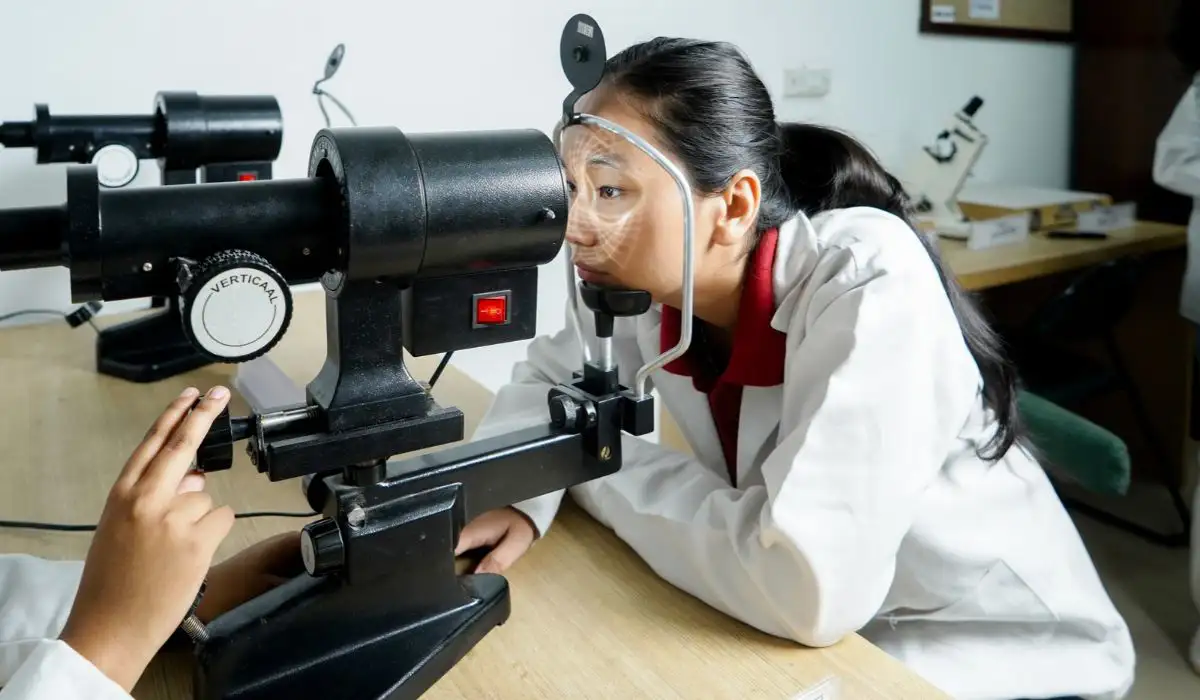
Optometry is a health care speciality concerned with vision and primary eye care. Optometrists perform refractions, supply optical appliances (spectacles and contact lenses) and treat binocular vision disorders. Patients suffering from eye diseases are referred to ophthalmologists.
B.Sc Optometry
Most B.Sc Optometry programs are offered in the University Science framework and are of 3 years’ duration of study followed by 6-12 months of clinical internship as part of the final year. Each university designs its own program; hence, there can be variation in terms of duration, clinical hours, etc.
Bachelor of Optometry (B.Optom)
The name of the degree to pursue Optometry is Bachelor of Optometry (B.Optom). The Ministry of Health’s model curriculum for the degree in Optometry has specified 4 years of study, including 1 year of compulsory internship. Recently, the NCAHP Act, 2021 has brought optometry under a national allied health regulator. As per the NCAHP rules for 2026–27, the degree to be taught in all Universities across the country is to be known as Bachelor of Optometry, running for five years, including 1 year of internship. The candidate can get admitted to this degree through NEET or any other equivalent Government exam.
Why the two names exist
For historical reasons, there are two names currently in use to denote the degree awarded in Optometry. As the NCAHP rules come into effect, more colleges are likely to change the name of their B.Sc Optometry program to B.Optom, offering more clinical training. However, for now, the name given to a degree awarded is of little consequence to the regulator, as long as it meets the requirements in terms of curriculum and internship.
Subjects and Skills: What Students Learn
Both the B.Sc Optometry degree and the Bachelor of Optometry degree studied on this course follow the same scientific core of study. However, the B.Optom degree incorporates more supervised clinical hours and a structured clinical internship as the final year of the degree. The national model curriculum for the degree is used as a basis for the course content, which includes the following areas of study.
- Foundation sciences: general anatomy and physiology, biochemistry, nutrition, microbiology and pathology (of the eye and in general).
- Optics: geometrical, physical and visual optics, and the use of instruments in optometry.
- Eye disease and pharmacology: The common ocular diseases like glaucoma, and systemic diseases affecting the eye. The ocular drugs used in the treatment of eye diseases.
- Clinical optometry: refraction, eye examination techniques and case history taking.
- Specialised care (Contact Lenses, Low Vision Aids, Binocular Vision etc. including Paediatrics and Geriatrics).
- Public health: community eye care, school screening and occupational vision.
- Professional skills such as research methods, biostatistics, optometric practice, medical ethics, optometric laws and patient interaction skills.
The final year of a Bachelor of Optometry is a full-time internship that takes place in a number of hospitals and eye clinics across the country. Students under the supervision of experienced optometrists see patients and complete a research project.
Career Opportunities and Salary
A graduate of either degree may work in hospitals, optical chains, private practice, public health programs, industry or even academia.
- Clinical optometrist in an eye hospital or multi-speciality hospital
- Optometrist at optical retail chains
- Contact lens or low vision specialist
- Paediatric or binocular vision (orthoptics) practitioner
- Community and school eye-screening optometrist
- Product or clinical specialist with lens and contact lens companies
- Clinical instructor, lecturer or researcher (usually after a master’s)
- Independent practice owner
Indicative salaries in India, per Careers360:
| Stage or sector | Typical salary (₹ per year) |
| Fresher | 2.5–4 lakh |
| Experienced | 4–7 lakh |
| Senior | 7–12 lakh |
| Government jobs | 3–5 lakh |
| Private hospitals and clinics | 3–6 lakh |
| Own practice, metro city | 10–20 lakh |
Salaries depend on city, employer and specialisation. A B.Optom graduate’s year of internship often helps at hospital interviews, since they arrive with real patient experience.
Comparison: B.Sc Optometry vs Bachelor of Optometry vs B.Sc Medical Lab Technology
B.Sc Optometry is a shorter version of the same program (The Bachelor of Optometry) that is a stronger clinical qualification. It is compared with B.Sc Medical Lab Technology (MLT), which is another allied health discipline that many students compare with optometry when making their decision to study.
| Factor | B.Sc Optometry | Bachelor of Optometry (B.Optom) | B.Sc Medical Lab Technology |
| Duration | Usually 3 years, often plus internship | 4 years (3+1) under the older model curriculum; 5 years including internship in NCAHP-aligned syllabi | Usually 3 years, often plus internship |
| Internship | Varies by university | 1 year, compulsory | Varies by university |
| Regulatory status | Older nomenclature, being phased into B.Optom | Standard NCAHP title | Some institutes have renamed it Bachelor of Medical Laboratory Science (BMLS) |
| Eligibility | 10+2 with Physics, Chemistry, Biology/Maths | 10+2 with PCB/PCM; NEET or equivalent in NCAHP-aligned admissions | 10+2, usually with PCB |
| Main work | Vision testing, lenses, eye screening | Same, with deeper clinical training | Blood, tissue and fluid testing in labs |
| Patient contact | High | High | Low to moderate |
| Typical employers | Optical chains, eye clinics, hospitals | Eye hospitals, clinics, practice, research | Diagnostic labs, hospitals, blood banks, research |
| Own practice possible | Yes | Yes, with better clinical readiness | Lab setup possible, but needs licences and pathologist oversight |
B.Sc Optometry is a shorter, more flexible route that can lead to a career in optical retailing/industry.
Pick Bachelor of Optometry if you want to practice in a hospital, in an independent clinic or if you want to practice elsewhere in the world and get registered there.
B.Sc Medical Lab Technology (MLT) is a different allied health career that students often weigh up against optometry. If you are interested in diagnostic work in a laboratory as opposed to patient care, then the B.Sc MLT is the course for you.
Future Scope
As the demand for optometrists continues to outstrip supply in India, India Vision Institute notes that there is a deficiency of approximately 1.3m eye-care workers needed against the 45,000 odd primary eye-care workers currently available to address the massive burden of blindness in the country. This gap has been noted since 2017.
Several trends keep that gap open:
- Trends of screen-based habits amongst children will lead to an increase in myopia and a rise in cases of digital eye strain.
- An ageing population requires treatment for cataract, glaucoma and other eye diseases.
- Organised optical retail chains are expanding into small towns.
- The country is due to be brought under the National Council for Assistance in Eye Care and Prevention (NCAHP) regulation, to improve recognition of the optometry profession and set out minimum qualifications required for practice.
- Technology like teleoptometry and screening with the aid of AI is creating new roles in rural eye care.
In addition to clinical practice, optometrists with a recognised degree can also opt to register to practice in other countries. Optometrists would need to satisfy licensing requirements for that country but can pursue an MSc or M.Optom, a PhD or specialise in contact lenses, pediatric optometry, low vision or sports vision, to name a few.
Government Universities and Chitkara University Offering Optometry Programs
Several government institutions offer optometry degrees, alongside Chitkara University. Seats at government institutes are limited and competitive. Durations and admission rules are changing as colleges align with NCAHP, so confirm current details on each official website.
| Institution | Programs | Duration | Location |
| All India Institute of Medical Sciences (AIIMS) | Bachelor of Optometry | 4 years | New Delhi |
| PGIMER | Bachelor of Optometry | 4 years | Chandigarh |
| King George’s Medical University (KGMU) | Bachelor of Optometry (from 2025–26) | 4 years (3 + 1 internship) | Lucknow, Uttar Pradesh |
| Aligarh Muslim University (AMU) | B.Sc Optometry | 3 years | Aligarh, Uttar Pradesh |
| Chitkara University | Bachelor of Optometry | 5 years (4 + 1 internship) | Punjab |
When shortlisting, check the program’s internship length, partner eye hospitals, clinical equipment and NCAHP alignment rather than the degree name alone.
Conclusion
B.Sc Optometry and the Bachelor of Optometry degree will equip you with the skills required to develop a career in eye care. Both programs have a focus on diagnostics, but the Bachelor of Optometry program provides more in-depth clinical training as well as a compulsory placement year and is aligned to the NCAHP’s national standards for clinical placements. The B.Sc Optometry degree would be suitable for a shorter training program that includes plenty of ‘hands-on’ practical training. In addition, if you are more interested in diagnostics as opposed to patient care, then B.Sc Medical Lab Technology is another degree worth comparing.
Before you apply for a program, consider the curriculum, internship placements and registration requirements. View the Bachelor of Optometry program page for details on the program structure, prerequisites and dates for application for this year’s intake.
Bachelor of Optometry at Chitkara University: B.Optom vs B.Sc. Optometry and Career Opportunities
B.Optom vs B.Sc. Optometry in India – A Comparative Study of both degrees for Optometry Colleges across the country, with a special reference to the Bachelor of Optometry course offered by Chitkara University for 9+2 students. The study aims to throw light on various career options available to graduates of Optometry.
In India, Bachelor of Optometry (B.Optom) and B.Sc. Optometry are 4-year undergraduate programs for Optometry, leading to a career in vision care and eye health. Although the major subjects to study in B.Optom and B.Sc. Optometry are more or less the same, the approach and the depth of study in specific areas may vary. In general, B.Optom programs concentrate on patient care, eye tests and diagnostic processes in optometry, whereas B.Sc. Optometry programs have more emphasis on the scientific basis of optics and vision. Above all, the quality of practical training, clinical exposure and recognition of the degree are crucial.
Chitkara University is conducting 5 years full time B.Optom program at Chitkara College of Pharmacy. The program is of 4 years + 1 year Internship. The course is designed to impart comprehensive knowledge of Eye Examinations, Ocular Health, Refractive Errors, Low Vision etc. The students would be exposed to practical sessions, specialist labs and clinical postings in leading Eye Care Organisations. As per the university’s published eligibility criteria, a student is required to be over 17 years of age with 50% marks in aggregate in Physics, Chemistry and Biology or Mathematics in Class XII. For further details, refer to the latest official brochure of the university regarding the fees, etc.
Optometrists can get jobs in Eye Hospitals, clinics, Optic stores of multinational companies dealing in Vision Care and even start their own Optical Practices. One can also opt for contact lens specialisation, working in Low Vision Rehabilitation, as Vision Care Consultant or even get into Optometry Education or Eye Care product Research & Development. We expect our students to have the capability to adapt to the changing needs of the Eye Care Industry. So when comparing B.Optom with B.Sc. Optometry program, it is better to look for clinical training, internship opportunities and career assistance that a university can offer rather than looking for the degree name.