A career in the Merchant Navy is one of the most financially rewarding and genuinely adventurous paths available to students in India. The merchant navy salary in India ranges from ₹25,000 per month for a fresher Deck Cadet to over ₹20,00,000 per month for an experienced Captain on an LNG vessel — making it among the highest-paying careers accessible directly after 12th grade. Salary structures in the Indian Merchant Navy are regulated by the Directorate General of Shipping (DGS), Ministry of Shipping, Government of India, and benchmarked against global wage guidelines set by the International Transport Workers’ Federation (ITF) — ensuring that Indian seafarers are paid at internationally competitive rates.
But the salary is only part of the picture. Tax-free income on foreign-flagged ships, zero living expenses onboard, paid leave equal to time at sea, and genuine international career mobility are all built into this profession. This guide covers everything you need to make an informed decision: job profiles, rank-wise and ship-type-wise salary data, entry pathways after 10th and 12th, factors that affect real take-home, and how institutions like Chitkara University School of Maritime Studies (CUSMS) prepare students for a life at sea.
Understanding Maritime Studies: A Foundation for Maritime Careers
Maritime Studies is the academic discipline that prepares students for careers at sea and in the broader maritime industry. Governed by the International Maritime Organization (IMO) and implemented in India through DGS-approved institutions, it covers navigation, marine engineering, maritime law, cargo operations, safety procedures, and maritime management — the complete operational knowledge required to work aboard commercial vessels.
The most direct entry into this field is the 3-Year B.Sc. in Nautical Science — a program that integrates theoretical education with hands-on practical training onboard ships. Students learn to operate navigation systems, handle cargo, apply maritime law, and respond to safety emergencies through actual sea experience, not just simulation. All practical training must meet the requirements of the STCW Convention (Standards of Training, Certification and Watchkeeping for Seafarers) — the international maritime training standard set by the IMO and enforced in India by DGS.
A recognized maritime education is the mandatory prerequisite for joining the Merchant Navy as an officer, and the foundation of every merchant navy salary progression that follows.
Merchant Navy Salary After 10th: The GP Rating Path
Students can join the Merchant Navy after 10th standard through the GP Rating (General Purpose Rating) pathway, earning ₹25,000–₹60,000 per month in a crew-level role. This is the non-officer entry route into the industry — no degree is required, only a DGS-approved pre-sea training certificate.
GP Ratings work as part of the deck or engine crew, handling maintenance, cargo operations, watchkeeping support, and general vessel duties under the supervision of officers. With accumulated sea time and additional certifications, GP Ratings progress through the ratings hierarchy:
- Eligibility: 10th pass (SSC), age 17–25, medical fitness as per DGS standards
- Training Duration: 6 months pre-sea training + sea service
- GP Rating (Trainee OS) salary: ₹25,000 – ₹60,000 per month
- Ordinary Seaman (OS) salary: ₹60,000 – ₹75,000 per month
- Able Seaman (AB) salary: ₹1,00,000 – ₹1,24,000 per month
- Bosun / Deck Fitter salary: ₹1,00,000 – ₹1,60,000 per month
While the GP Rating path offers accessible entry after 10th, the officer pathway — available to students who complete 12th with Physics, Chemistry, and Mathematics — leads to significantly higher long-term earnings and faster progression toward officer grades with substantially greater responsibility and pay.
Merchant Navy Salary After 12th: The Officer Career Path
The merchant navy starting salary after 12th is ₹25,000–₹85,000 per month as a Deck Cadet, rising to ₹2,00,000–₹3,50,000 per month within 12–18 months of clearing the Third Mate COC (Certificate of Competency, issued by DGS) examination. This is the officer career track — the path that leads to Captain and Chief Engineer salaries of ₹10–20 lakh per month.
Here is how the progression looks after completing 12th with PCM:
- Step 1: Complete B.Sc. Nautical Science (3 years, including mandatory 12-month sea internship)
- Step 2: Join as Deck Cadet — earn ₹25,000–₹85,000/month
- Step 3: Clear Third Mate COC examination and progress to Third Officer
- Step 4: Accumulate sea time, clear higher COC exams, advance through Second Officer, Chief Officer, and eventually Captain
Salary escalates rapidly at each COC level. By the 5–8 year mark, most actively sailing officers earn ₹5,00,000–₹8,00,000 per month — frequently entirely tax-free as NRI (Non-Resident Indian) income when sailing on foreign-flagged vessels for 183+ days per financial year.
Merchant Navy Job Profiles and Salary by Rank
The Merchant Navy has two primary departments — Deck and Engine — each with a rank ladder from Cadet to Captain/Chief Engineer, plus a specialist ETO (Electro-Technical Officer) role and a separate Ratings department. Salaries vary by rank, vessel type, and employer. Here is the complete profile of every major role:
1. Deck Cadet (Trainee Navigating Officer)
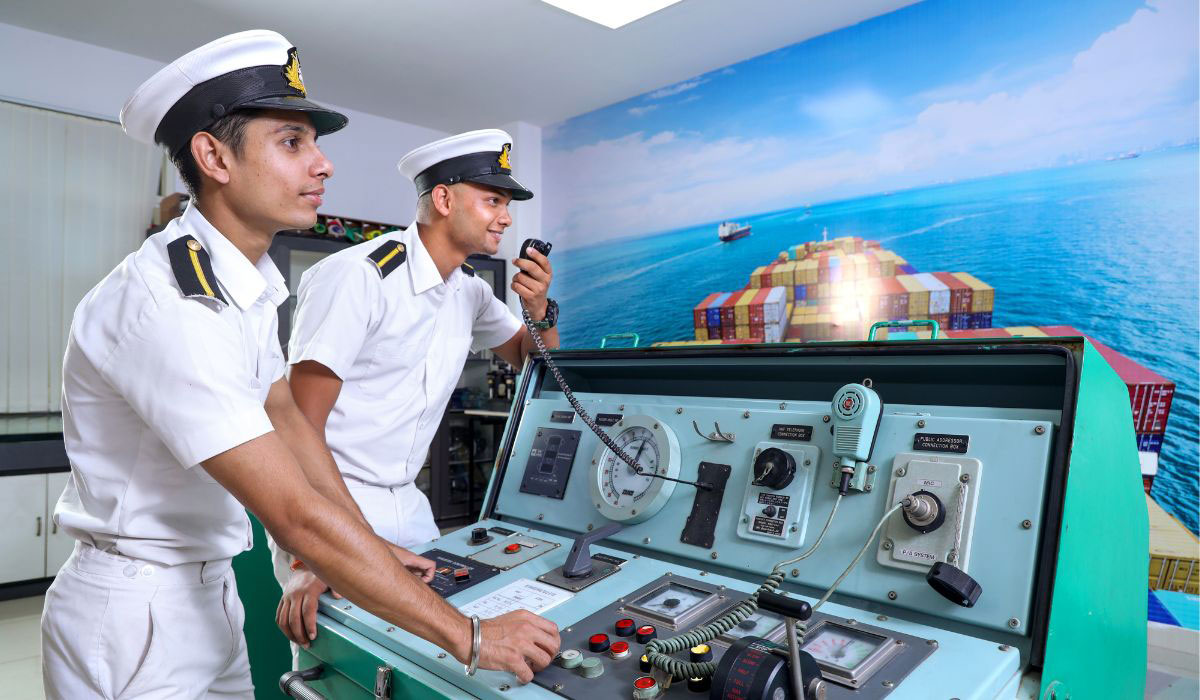
The entry point of every officer’s career at sea. Deck Cadets are recent maritime academy graduates undergoing practical training onboard ships under senior officer supervision. They assist with navigation, cargo handling, seamanship, and general deck operations.
- Responsibilities: Navigation assistance, watchkeeping support, cargo operations, logbook entries, deck maintenance
- Deck cadet salary in merchant navy: ₹25,000 – ₹85,000 per month
- Perks: Free food, accommodation, and travel while onboard
2. Third Officer (Third Mate)
After completing the required sea time as a Deck Cadet and clearing the Third Mate COC examination, candidates are promoted to Third Officer — the first independent watchkeeping officer rank with real navigational and safety responsibility.
- Responsibilities: Independent watchkeeping, navigation, safety equipment maintenance, lifeboat and firefighting drills
- 3rd officer salary in merchant navy (Dry Cargo): ₹2,00,000 – ₹3,00,000 per month
- 3rd officer salary in merchant navy (Tanker): ₹2,15,000 – ₹3,50,000 per month
- Sea time required: 12–18 months
3. Second Officer (Second Mate)
The Second Officer is the ship’s navigator and designated medical officer, responsible for chart corrections, passage planning, and communication officer duties. This rank requires a higher COC and more accumulated sea time than Third Officer.
- Responsibilities: Advanced navigation, chart and passage management, cargo plan oversight, medical duties, communication officer
- 2nd officer salary in merchant navy (Dry Cargo): ₹2,15,000 – ₹3,50,000 per month
- 2nd officer salary in merchant navy (Tanker): ₹3,30,000 – ₹4,00,000 per month
- Sea time required: 3–5 years
4. Chief Officer (First Mate)
The Chief Officer is the second-in-command aboard the vessel. They oversee the entire deck department, manage cargo operations and stowage, maintain stability calculations, and are directly responsible for crew safety — working alongside the Captain at all times.
- Responsibilities: Deck department management, cargo planning and stowage, stability and trim calculations, safety and environmental compliance, vessel security officer
- Chief Officer salary in merchant navy (Dry Cargo): ₹5,40,000 – ₹7,10,000 per month
- Chief Officer salary in merchant navy (Tanker): ₹6,50,000 – ₹8,00,000 per month
- Sea time required: 6–8 years
5. Master (Captain)
The Captain holds the highest rank aboard any merchant vessel. The Captain is solely and legally responsible for the ship, its cargo, its crew, and full compliance with all IMO and SOLAS (Safety of Life at Sea) regulations — a role built on 12–15+ years of sea service and multiple DGS-issued competency certifications.
- Responsibilities: Full command of ship, crew safety and welfare, compliance with IMO and SOLAS regulations, port authority liaison, incident command
- Merchant navy captain salary (Dry Cargo): ₹6,60,000 – ₹8,30,000 per month
- Merchant navy captain salary (Tanker / LNG): ₹10,00,000 – ₹20,00,000 per month
- Sea time required: 12–15+ years
6. Fourth Engineer
The most junior watchkeeping engineer officer in the engine department, responsible for operating the engine room under supervision and maintaining auxiliary machinery systems such as purifiers, compressors, and auxiliary engines.
- Responsibilities: Engine room watchkeeping, auxiliary machinery maintenance, fuel and oil record management
- 4th engineer merchant navy salary: ₹2,00,000 – ₹3,50,000 per month
- Sea time required: 12–18 months post-cadetship
7. Third Engineer
The Third Engineer manages specific machinery systems — typically boilers, fuel systems, or refrigeration plant — and takes independent engine room watches as the 2nd Engineer’s understudy.
- Responsibilities: Independent engine room watches, boiler and fuel system management, cooler water tests, watchkeeping
- 3rd engineer salary in merchant navy (Dry Cargo): ₹3,30,000 – ₹4,00,000 per month
- 3rd engineer salary in merchant navy (Tanker): ₹3,30,000 – ₹4,16,000 per month
- Sea time required: 3–5 years
8. Second Engineer
The Second Engineer is the Chief Engineer’s deputy, directly responsible for the day-to-day technical operations and maintenance of all engine room machinery, including the ballast system and firefighting equipment.
- Responsibilities: Engine room operations management, planned maintenance scheduling, watchkeeping oversight, fuel efficiency
- Second engineer salary in merchant navy (Dry Cargo): ₹5,40,000 – ₹7,10,000 per month
- Second engineer salary in merchant navy (Tanker): ₹6,50,000 – ₹8,00,000 per month
- Sea time required: 6–8 years
9. Chief Engineer
The Chief Engineer is the most senior engineering officer onboard and is responsible for the entire engine department — all propulsion machinery, auxiliary systems, electrical systems, and the overall technical integrity of the vessel.
- Responsibilities: Full technical command of vessel, engine department management, DGS compliance, machinery performance optimization
- Chief engineer salary in merchant navy (Dry Cargo): ₹6,60,000 – ₹8,30,000 per month
- Chief engineer salary in merchant navy (Tanker / LNG): ₹10,00,000 – ₹18,00,000 per month
- Sea time required: 12–15+ years
10. Electro-Technical Officer (ETO)
The ETO is a specialist officer role that has grown significantly in demand as modern vessels become increasingly automated and digitally complex. The ETO manages all electrical, electronic, and automation systems onboard — from navigation electronics and GMDSS (Global Maritime Distress and Safety System) equipment to integrated ship automation and control systems.
- Eligibility: B.E./B.Tech in Electrical or Electronics Engineering + DGS-approved ETO pre-sea course
- Responsibilities: Navigation electronics, ship automation, electrical maintenance, GMDSS, communication systems
- ETO salary in merchant navy: ₹2,50,000 – ₹5,00,000 per month
- Note: ETO salaries vary significantly by vessel type — LNG tankers and DP (Dynamic Positioning) vessels pay at the higher end
Also read: A Comprehensive Guide to Ranks in the Merchant Navy
Merchant Navy Salary in India: Complete Rank-Wise Table
Here is the complete merchant navy salary per month in India across all ranks, departments, and vessel types:
| Merchant Navy Salary India — as of 2025–26, benchmarked against DGS and ITF (International Transport Workers’ Federation) wage guidelines | ||||
|---|---|---|---|---|
| Rank | Department | Dry Cargo (Monthly) | Tanker / LNG (Monthly) | Experience Required |
| GP Rating (Trainee OS) | Deck / Engine Crew | ₹25,000 – ₹40,000 | ₹30,000 – ₹60,000 | After 10th (DGS certificate) |
| Able Seaman (AB) | Deck Crew | ₹1,00,000 – ₹1,24,000 | ₹1,00,000 – ₹1,24,000 | 2–3 years sea time + DGS cert |
| Bosun / Deck Fitter | Deck Crew | ₹1,00,000 – ₹1,60,000 | ₹1,00,000 – ₹1,60,000 | 4–6 years |
| Deck / Engine Cadet | Deck / Engine | ₹25,000 – ₹70,000 | ₹30,000 – ₹85,000 | Fresher (Post B.Sc. / B.E.) |
| Third Officer / Fourth Engineer | Deck / Engine | ₹2,00,000 – ₹3,00,000 | ₹2,15,000 – ₹3,50,000 | 12–18 months |
| Second Officer / Third Engineer | Deck / Engine | ₹2,15,000 – ₹4,00,000 | ₹3,30,000 – ₹4,16,000 | 3–5 years |
| ETO (Electro-Technical Officer) | Electrical | ₹2,50,000 – ₹5,00,000 | 2–5 years | |
| Chief Officer / Second Engineer | Deck / Engine | ₹5,40,000 – ₹7,10,000 | ₹6,50,000 – ₹8,00,000 | 6–8 years |
| Captain (Master) / Chief Engineer | Deck / Engine | ₹6,60,000 – ₹8,30,000 | ₹10,00,000 – ₹20,00,000 | 12–15+ years |
Salary ranges sourced from DGS-approved industry benchmarks, ITF Minimum Wage guidelines (2025–26), and current Indian and international shipping company offer data. Actual salaries vary by company, vessel flag, and individual experience.
Key Benefits Beyond the Basic Salary:
- Free accommodation and meals onboard — zero living expenses while at sea
- Tax-free income for NRIs on foreign-flagged ships (when sailing 183+ days outside India in a financial year, as per the Income Tax Act, 1961)
- Paid leave between contracts — typically equal to time spent at sea
- Overtime pay: additional duties can add ₹30,000–₹2,00,000 per month above the base salary, depending on rank and ship type
- Risk/hazard allowance for tanker and LNG crew
- Contract completion bonuses offered by many international shipping companies
- Medical and insurance coverage during active contracts
When accounting for zero living expenses at sea and full tax exemption for qualifying NRIs, the effective value of a merchant navy salary is substantially higher than the raw figure suggests. A Chief Officer earning ₹7,00,000 per month with no rent, no food cost, and no income tax is, in real terms, far ahead of an onshore professional at the same nominal number.
Factors That Affect Merchant Navy Salary in India
Six key factors determine where a seafarer falls within the salary ranges above: rank, ship type, employer, experience within rank, certifications held, and the flag state of the vessel. Understanding these helps you plan your career to maximise earnings at every stage.
- Rank: The single biggest driver. Every COC-based promotion brings a step-change in salary — not just an incremental raise.
- Ship type: Tankers, LNG carriers, and chemical carriers pay a premium due to the hazardous nature of cargo and the specialist knowledge required. Bulk carriers and general cargo ships pay less at equivalent ranks. Cruise ships follow a different model with service incentives added to base pay.
- Employer / company: International operators such as Maersk, Anglo Eastern, Fleet Management, MSC, and MOL offer some of the highest packages in the industry. Indian government-owned SCI and private companies are competitive but generally lower at senior levels.
- Experience within rank: Even within the same rank, a newly promoted Third Officer earns less than one with three years at that grade. Most companies operate incremental pay bands within each rank.
- STCW certifications and endorsements: Tanker endorsements, DP (Dynamic Positioning) certification, ECDIS, and advanced firefighting certificates all directly unlock access to higher-paying vessel categories and affect offered salary at the same rank level.
- Flag state of the vessel: Indian-flagged ships pay in INR and income is taxable. Foreign-flagged ships (Panama, Liberia, Marshall Islands registry, etc.) typically pay in USD — and for seafarers who qualify as NRIs, this income is entirely tax-free under Indian law.
Merchant Navy Salary After 5 Years
After 5 years in the Merchant Navy, most actively sailing officers earn ₹4,00,000–₹8,00,000 per month, having reached the Second Officer, Third Engineer, or approaching Chief Officer / Second Engineer grade. For officers on foreign-flagged vessels who qualify as NRIs, this is entirely tax-free.
The typical year-by-year progression:
- Year 0–1 (Cadet): ₹25,000 – ₹85,000 per month
- Year 1–2 (Third Officer / Fourth Engineer): ₹2,00,000 – ₹3,50,000 per month
- Year 3–5 (Second Officer / Third Engineer): ₹2,15,000 – ₹4,16,000 per month
- Year 5+ (Approaching Chief Officer / Second Engineer): ₹5,40,000 – ₹8,00,000 per month
This trajectory is difficult to match in most other professions accessible from the same academic starting point after 12th — particularly when the tax-free benefit on foreign-flagged vessels is factored in.
Private vs Government Merchant Navy: Salary Comparison
International private operators on foreign-flagged vessels pay the highest merchant navy salaries in India — typically in USD and entirely tax-free for qualifying NRIs. Indian government and private companies offer more stability but lower peak salaries at senior ranks.
- International companies (foreign-flagged ships): The highest-paying category. Salaries paid in USD/EUR. Income is tax-free for NRI-qualifying seafarers. Companies like Maersk, Anglo Eastern, Fleet Management, and Bernhard Schulte are among the top payers.
- Private Indian shipping companies (Great Eastern Shipping, Tolani Shipping, Essar Shipping): Competitive at junior ranks, higher than government at senior levels. More performance-linked increments. Income is taxable as it is earned on Indian-flagged vessels in most cases.
- SCI (Shipping Corporation of India — Government-owned): Structured salary bands, pension benefits, better job security, and standardized DGS-aligned increments. Slightly lower base pay at senior ranks compared to top private operators, but with greater long-term stability and structured career advancement.
Key Insights for Aspiring Mariners
- Global exposure, not just travel: Working in the Merchant Navy means visiting ports across the world — Rotterdam, Singapore, Houston, Dubai, Cape Town. It builds genuine cross-cultural professional experience that few land-based careers can offer.
- Merit-based, transparent progression: Unlike many industries where advancement depends on organizational politics, the Merchant Navy has a DGS examination-based rank system. Progression is tied to sea time served and COC examinations cleared — predictable, transparent, and fair.
- Sustained job security: Over 80% of international trade by volume moves by sea. Shipping is not a discretionary sector — it is foundational global infrastructure. Demand for qualified Indian officers continues to grow as the global fleet expands.
- Work–leave balance: A typical contract runs 4–5 months at sea followed by an equal period of paid leave ashore. This rhythm suits professionals who value extended, uninterrupted time at home between voyages.
- Certifications drive salary more than seniority alone: STCW special certificates, tanker endorsements, DP certification, and specialized vessel qualifications directly unlock access to higher-paying roles. Targeted certification investment is one of the clearest salary accelerators in a maritime career.
A career in the Merchant Navy is more than a job. It is a structured, DGS-regulated profession that rewards sea service, continuous certification, and discipline with some of the most competitive and tax-efficient salaries accessible to Indian graduates — across any industry.
Begin Your Maritime Career at Chitkara University School of Maritime Studies (CUSMS)
For students in North India looking to build a career in the Merchant Navy, Chitkara University School of Maritime Studies (CUSMS) offers one of the most structured and industry-recognized maritime education programs in the region.
Why CUSMS:
- Fully accredited by the Directorate General of Shipping (DGS), Ministry of Shipping, Government of India
- Curriculum built to DGS Scheme of Training and STCW Convention standards — ensuring graduates meet global maritime certification requirements
- Offers a 3-year B.Sc. Nautical Science degree with a mandatory 12-month internship onboard merchant navy ships
- Small classroom sizes ensuring personalized, focused instruction
- Faculty with active sea-going industry experience — real shipboard professionals guiding the next generation
- Practical exposure to real shipboard scenarios builds problem-solving and crisis-management skills from early in the program
- Dedicated placement support connecting graduates with top domestic and international shipping companies
CUSMS graduates begin their careers as Deck Cadets, equipped with the DGS-compliant skills, certifications, and practical sea time required to progress steadily toward the rank of Captain — and the ₹10–20 lakh per month merchant navy captain salary that comes with command on premium vessels. For a closer look at where CUSMS graduates build their careers, visit CUSMS Placements.
The program is open to students from Punjab, Haryana, Himachal Pradesh, Uttarakhand, Jammu and Kashmir — and beyond.
Also read: Chart A Career in Merchant Navy
Comprehensive Educational Programs and Practical Exposure
CUSMS is committed to offering DGS-aligned, industry-led programs that match the dynamic demands of the global maritime sector. Small classroom sizes ensure personalized attention and a genuine depth of understanding — not a factory-model approach to maritime training.
Faculty with active sea-going records guide students into capable, confident mariners. Practical exposure to real onboard situations — cargo operations, navigation watchkeeping, emergency response, and damage control drills — builds the instinct and composure that distinguish effective officers from those who merely pass exams.
3-Year B.Sc. in Nautical Science and Career Prospects
CUSMS’s three-year residential B.Sc. Nautical Science degree includes a mandatory 12-month internship on merchant navy ships. The program is structured to build technical knowledge, practical sea skills, professional discipline, and the team-first mindset that shipboard life demands — all within a DGS and STCW-compliant curriculum.
CUSMS graduates progress from Deck Cadet to Chief Officer and eventually Captain — developing the situational awareness, leadership, and adaptability that define the best maritime professionals. For students who want a profession combining high earnings, international exposure, and clear merit-based progression, CUSMS provides a proven, accredited starting point.