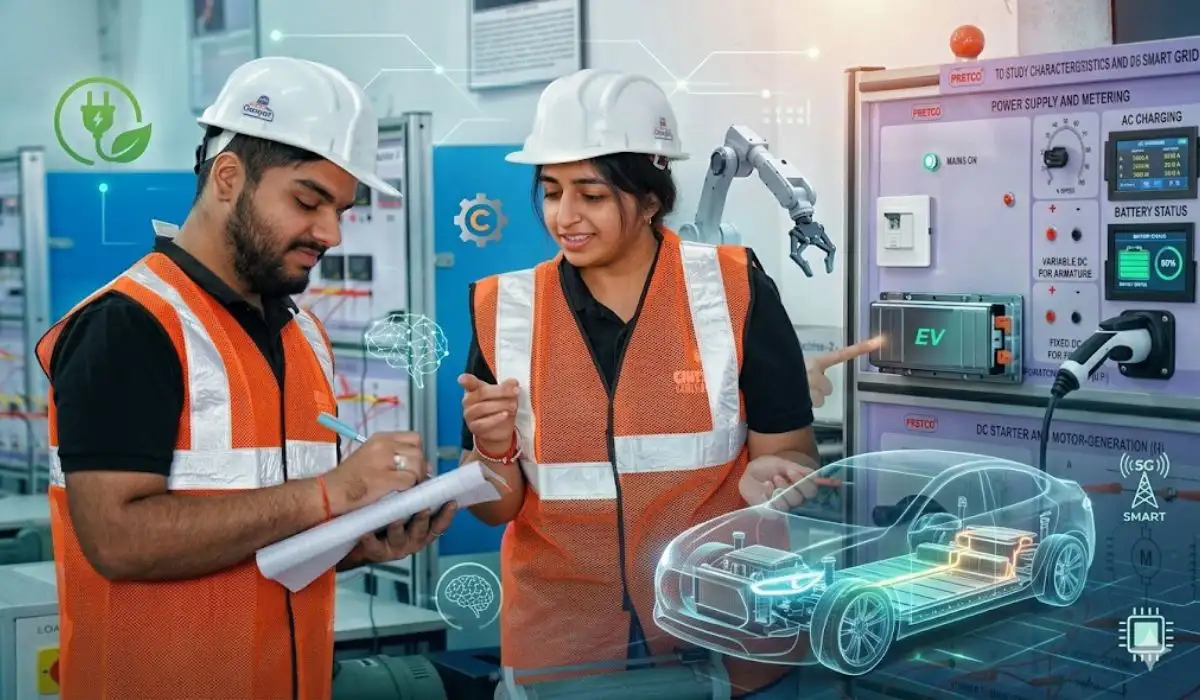

Electrical Engineering in India is entering a golden era. With AI, electric vehicles, renewable energy , and industrial automation reshaping every sector, the scope of Electrical Engineering has never been broader or more financially rewarding.
| Quick Facts | Details |
| Field | Electrical Engineering |
| Duration | 4 years (B.E/B.Tech) |
| Eligibility | Class 12 with PCM, 50%+ marks |
| Top growth areas | EVs, AI Automation, Renewable Energy, Robotics, Smart Cities |
| Entry-level salary | ₹4 – ₹8 LPA |
| Top specialist salary | ₹8 – ₹18 LPA |
| Government recruiters | ISRO, DRDO, NTPC, BHEL, Indian Railways |
| Top private recruiters | ABB, Schneider Electric, L&T, Reliance, Wipro, Tata Motors |
The scope of subject of Electrical Engineering has exponentially increased for growing Electrical Engineering jobs in India for students and working professionals alike. As the opportunities in Electrical Vehicles sector, Automation in Smart Factories, AI based automation and intelligent energy systems have opened up for the subject of Electrical Engineering.
What Is Electrical Engineering And How Has It Changed?
Electrical Engineering is the branch of engineering that deals with electricity, electronics, electromagnetism, power generation, control systems, and automation. But the field has transformed dramatically over the last decade.
Today, electrical engineers are not just working on power distribution. They are:
- Designing battery management systems for electric vehicles.
- Building AI-powered automation systems for smart factories.
- Developing solar and wind energy grids for a cleaner India.
- Programming robotics systems for precision manufacturing.
- Creating embedded systems for IoT-connected devices.
- Working on semiconductor and chip design for next-gen electronics.
This evolution is exactly what makes the scope of Electrical Engineering in India so compelling right now. The foundational skills of the discipline now plug directly into some of the highest-growth industries in the country.
Modern electrical engineers now work on:
- Smart electrical grids
- Electric vehicles
- AI-integrated systems
- Renewable energy technologies
- Robotics and industrial automation
- IoT-enabled devices
- Semiconductor systems
- Intelligent manufacturing systems
India’s technological growth and infrastructure development are making Electrical Engineering one of the most future-ready branches of engineering.
Why Electrical Engineering is Growing Rapidly in India
Several industries are driving demand for electrical engineers:
Electric Vehicle (EV) Revolution
India is aggressively moving toward electric mobility. EV startups and automobile companies are hiring engineers for:
- Battery management systems
- Charging infrastructure
- Motor control systems
- Power electronics
- Embedded systems
Leading companies in this sector include:
- Tata Motors
- Ola Electric
- Ather Energy
- Mahindra Electric
AI and Automation
Artificial Intelligence and automation are transforming factories and industrial systems.
Electrical engineers work on:
- Robotics systems
- PLC and SCADA automation
- AI-enabled machines
- Industrial sensors
- Smart manufacturing
Automation companies are increasingly hiring engineers with multidisciplinary skills.
Renewable Energy Expansion
India is heavily investing in solar and wind energy projects. Electrical engineers are required for:
- Solar power systems
- Wind energy systems
- Smart energy grids
- Power distribution
- Energy storage systems
This sector offers long-term stability and sustainable career growth.
What You Learn in an Electrical Engineering Degree
Understanding the curriculum helps you assess whether Electrical Engineering matches your interests and strengths.
Core Subjects
- Electrical Machines and Power Systems
- Circuit Theory and Power Electronics
- Control Systems and Digital Electronics
- Microprocessors and Embedded Systems
- Signals and Systems
- Renewable Energy Systems
- Instrumentation and Measurement
Technical Skills You Build
- PLC and SCADA automation programming
- Circuit design and simulation
- AI and IoT system integration
- Robotics fundamentals
- Embedded system development
- Data interpretation and analytical problem-solving
Students who combine these core skills with specialisations in AI, EV technology, or automation gain a significant competitive edge in the Electrical Engineering jobs in India market.
Career Opportunities After Electrical Engineering
The electrical engineering scope India offers today is highly diverse. Graduates can work in both core engineering industries and advanced technology sectors.
Top Career Options
| Job Role | Average Salary in India |
| Electrical Design Engineer | ₹4 – ₹8 LPA |
| Power Systems Engineer | ₹4 – ₹9 LPA |
| Automation Engineer | ₹5 – ₹10 LPA |
| EV Design Engineer | ₹6 – ₹12 LPA |
| Robotics Engineer | ₹7 – ₹15 LPA |
| Embedded Systems Engineer | ₹6 – ₹14 LPA |
| AI & Smart Systems Engineer | ₹8 – ₹18 LPA |
These salary figures show the improving trend in electrical jobs salary India, especially for professionals with automation and EV-related expertise.
Government Sector Opportunities
Electrical Engineering jobs in India’s government sector remain among the most stable and respected career paths available:
- Indian Railways — one of the largest employers of electrical engineers in the world
- BHEL (Bharat Heavy Electricals Limited)
- NTPC (National Thermal Power Corporation)
- ISRO — for electronics and power systems roles
- DRDO — defense research and development
Government roles offer structured salary scales, job security, pension benefits, and long-term growth, making them a strong parallel track to private sector careers.
Government jobs provide stability, attractive salaries, and long-term growth opportunities.
Future Scope of Electrical Engineering in India
The future of Electrical Engineering in India looks extremely promising due to technological advancements and industrial growth.
Major Growth Areas
- Smart Cities Smart infrastructure projects require intelligent electrical systems and automation technologies.
- Electric Vehicles The EV ecosystem is expected to create lakhs of jobs in the coming decade.
- Renewable Energy India’s renewable energy targets are increasing demand for power engineers.
- AI-Powered Automation Industries are rapidly shifting toward automated and intelligent systems.
- Semiconductor and Electronics Manufacturing India’s focus on electronics manufacturing is opening new opportunities in chip design and embedded systems.
These developments are continuously expanding the electrical engineering scope India offers to students.
Best Universities and Programs for Electrical Engineering in India
Students interested in Electrical Engineering can explore top institutions offering specialised programs.
Leading Universities and Institutes
- Indian Institutes of Technology
- National Institutes of Technology
- Delhi Technological University
- Chitkara University
Many universities now also offer specialisations in:
- EV Technology
- Robotics and Automation
- AI & IoT
- Renewable Energy Systems
- Smart Grid Technologies
Should You Choose Electrical Engineering? An Honest Assessment
Electrical Engineering Is the Right Choice If You:
- Are fascinated by how electrical and electronic systems work
- Want to be part of India’s EV, renewable energy, or automation revolution
- Are interested in both hardware engineering and emerging technologies like AI and IoT
- Want the option of government sector stability alongside strong private sector salaries
- Enjoy hands-on, problem-solving work in labs and industry environments
Electrical Engineering May Not Be the Right Fit If You:
- Have no interest in physics, electronics, or mathematical analysis
- Prefer purely software-based or desk-bound careers
- Are looking for a discipline with no hands-on technical component
If software is your primary interest, Computer Science Engineering may be a better match. If management is your goal, the IPM Course after 12th at Chitkara University is worth exploring.
Conclusion
Electrical Engineering is one of the fastest growing & vibrant engineering discipline in India today. With AI, EVs, Automation & Smart Solutions and Renewable Energy Solutions emerging rapidly, the opportunities have increased many fold for an electrical engineer and thus there shall be huge growth in demand of skilled engineers in years to come.
An Electrical Engineering graduate can have excellent career options with excellent salary and excellent growth. He/she can work in Government organisations or in various other EV Startups or in robotics companies or in setting up smart manufacturing units or in renewable energy systems etc.
Students with interest in innovation, latest technology, green and sustainable energy systems and intelligent systems can have best future ahead by taking up Electrical Engineering as their future ready option.
4-Year B.E. in Electrical Engineering at Chitkara University
4-Year B.E. in Electrical Engineering at Chitkara University is specially designed to equip students to face Power Scenario, Automation, Electronics & Smart Technologies growing rapidly to meet today’s changing world. It provides in-depth knowledge of Electrical Systems & Power Distribution, especially Reliability and Efficiency, Renewable Energy, Industrial Automation and allied fields. The Electrical Engineering program at Chitkara University has a strong foundation of knowledge with practical exposure to latest technologies and ideas in the field of Electrical Engineering. Students are trained to design, analyse, operate and maintain Electrical Systems and their applications in industries. These systems are being optimised to meet challenges of modern world. Also, students are exposed to Industrial Training of minimum six months to one year in leading organisations of the country to provide hands-on experience before they complete their degree.
The Curriculum is specially designed to provide cutting edge training in power systems. Chitkara University focuses on making students ready for the industry with innovative pedagogy. Students are equipped to handle problems and work in power systems, design, develop, manage, maintain and install electrical systems to meet industrial requirements. The students also get to undergo 6-months to 1-year industrial training and internship in leading industry to provide practical exposure to students. Latest labs have been set up in the university such as Power Electronics lab, Control Systems lab, Protection and Switchgear lab, Electrical Machines lab, Schneider Electric’s Low & High Voltage Lab, Automation Centre of Excellence, Fuji Electric Technical Academy (FETA) etc. to provide practical knowledge to the students. To inculcate aspect of coding in core engineering and to provide skills to students to work in IT as well as core engineering sectors, Minor in Computer Science Engineering is provided to students from second semester onwards. The minor includes study of various subjects such as Object-Oriented Programming, Data Structures, Web Technology, etc.
As an Electrical Engineer from Chitkara University, you would have ample opportunities of working in various industries such as Generation, Transmission and Distribution of Power, Telecommunication Companies, Automated manufacturing Units, Design & development Units for industrial equipment, Solar & wind energy powerhouses etc. Some of the possible roles that an Electrical Engineer can take up are: Electrical Engineer, Automation Engineer, Power Engineer, Control Systems Engineer, Instrumentation Engineer, Renewable Energy Engineer and Telecommunications Engineer. The strong industrial placement cell of Chitkara University which consists of many big names such as ABB, Schneider Electric, Reliance Industries, Larsen & Toubro, Wipro, Mitsubishi Electric and many more enables the students to get placed in best companies of the world. We at Chitkara University believe in providing a well rounded experience to the students, through strong academic support, best in class industry relevant training and practical problem solving skills so that they can face challenges of emerging fields like AI, EVs, Automation etc. and achieve success in their chosen careers.