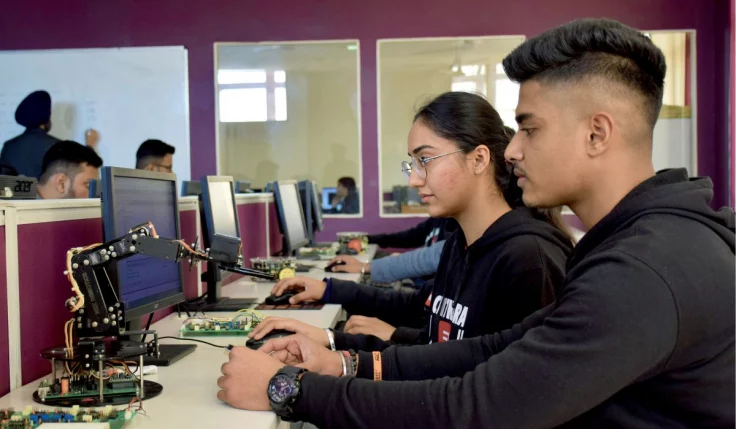

Artificial Intelligence Engineering, as a specialised technology stream, is gaining traction amongst student communities as a new and interesting way to develop intelligent systems, build machine learning models and create AI enabled applications. Industry, across software, healthcare, banking, e-commerce, automotive and other sectors, is rapidly developing and consuming AI Engineering resources and talent in India. An AI Engineering course would basically cover key elements of programming, data structures and algorithms, databases and key elements of AI and related computing disciplines that form the basis of AI Engineering.
Quick Answer
What is Artificial Intelligence Engineering?
Artificial Intelligence Engineering is a discipline that is practised as an engineering-focused subject. The field combines subjects like Computer Science, Engineering using programming, mathematical subjects, data and AI-related subjects for designing intelligent applications and systems.
What does an AI Engineering course cover?
The content of an AI Engineering program may vary from university to university. However, it would include Programming, Data structures and algorithms, Databases, Artificial Intelligence, Machine learning, Data Analytics and Computer Systems and other emerging technologies.
What skills are required?
Ability to apply fundamental programming skills, analytical thinking, mathematical skills and problem solving ability, along with the ability to handle large amounts of data and learning fundamentals of Machine Learning.
What are the career opportunities?
Graduate roles may include AI Engineer, Machine Learning Engineer, Data Scientist, AI Developer, Data Analyst, Software Engineer, and a variety of other technology related roles depending on skill and experience.
What Is Artificial Intelligence Engineering?
Artificial Intelligence Engineering is a new field that combines the fundamentals of computer science and artificial intelligence to enable AI systems to perform intelligent tasks that typically require human intelligence to perform.
Systems can be designed to recognise patterns, process data, predict future occurrences, automate processes and to support people in making decisions. Today, AI is used in Business, Industry, Health Care, Finance, Education, retail, transportation and many more fields.
For students interested in AI Engineering, the subject is not just about using AI tools. There is also a need for students to have a solid foundation in programming, algorithms, mathematics, computing systems and data to understand how to develop and deploy solutions that use AI..
Artificial Intelligence Engineering Course in India
An undergraduate AI Engineering pathway generally follows a four-year engineering structure, although the exact course title, curriculum and specialisation may differ between universities.
A typical program may introduce students to:
- Programming and computational thinking
- Data structures and algorithms
- Object-oriented programming
- Database management
- Computer networks
- Operating systems
- Artificial Intelligence
- Machine Learning
- Data Analytics
- Deep Learning
- Natural Language Processing
- Computer Vision
- Cloud and emerging technologies
- Software engineering
- AI applications and projects
The exact subjects vary by university. Students should therefore compare the curriculum, practical components, faculty expertise, industry exposure, internships and project opportunities before selecting a program.
What Do Students Learn in Artificial Intelligence Engineering?
Programming
Programming is at the core of most of the applications that use AI. You will be learning to write code to develop applications, work with data and so on.
As the main programming language for many AI applications and data-related work, Python is used in the course. Knowledge of other programming languages is also useful for some roles and in certain technology environments.
Mathematics and Statistics
We cover the basics of mathematics and statistics in the form of probability, statistics, linear algebra and even mathematical modelling.
This helps them to understand how the algorithm has learned from the data and how it will make predictions or classifications.
Data Structures and Algorithms
Data structures and algorithms: You learn how to organise information and how to solve computational problems efficiently.
These are also essential for a career in software engineering and for technical interviews.
Machine Learning
Machine learning: AI systems can identify patterns in data, make predictions, or make decisions.
Some examples of what they can learn in this subject are supervised learning, unsupervised learning, model evaluation and predictive modelling.
Artificial Intelligence
In this area, you will learn the different techniques for creating intelligent applications and systems.
Content of the subject area as covered in the course depends on the curriculum but covers areas like search, reasoning, knowledge representation for making intelligent decisions.
Data and Computing Technologies
With more and more modern AI solutions based on data and computing, students benefit from knowing about databases, cloud-based services, data processing as well as software development practices.
Skills Required for a Career in AI Engineering
A successful AI professional needs a combination of technical knowledge and professional skills.
Technical Skills
- Programming
- Data structures and algorithms
- Mathematics and statistics
- Machine learning
- Data analysis
- Database management
- Software development
- AI frameworks and tools
- Cloud and computing technologies
- Model development and evaluation
Professional Skills
Technical skills alone are not enough. Employers also value:
- Analytical thinking
- Problem-solving
- Communication
- Teamwork
- Project management
- Curiosity and continuous learning
- Ability to understand business requirements
Hands-on Experience
Projects and internships can help students understand how AI concepts work outside the classroom.
Students can build projects involving:
- Predictive analytics
- Recommendation systems
- Chatbots
- Computer vision
- Natural language processing
- Automation
- Data-driven applications
The focus should be on understanding the problem, selecting an appropriate approach and evaluating the outcome rather than simply using an AI tool.
Career Scope of Artificial Intelligence Engineering
Opportunities are growing in a wide range of industries, including technology and business. Many of these new roles are outlined below.
AI Engineer – Develops and integrates AI-based systems.
Machine Learning Engineer – Builds and deploys machine learning models.
Data Scientist – Analyses data to generate actionable insights.
AI Developer – Develops applications using AI technologies.
Data Analyst – Analyses data to support business decisions.
Software Engineer – Builds software applications, including AI-enabled solutions.
AI/Technology Consultant – Helps organisations identify and implement technology solutions.
Salaries and opportunities for work vary by skill set, job title, organisation, geographic location, and amount of experience. Acquiring strong technical skills and creating a portfolio of work on real projects will likely increase chances for success.
Artificial Intelligence Engineering vs B.Tech CSE
Students often compare an AI-focused engineering pathway with Core Computer Science and Engineering.
| Factor | AI Engineering | Core CSE |
| Primary focus | AI, ML, data and intelligent systems | Broad computer science |
| Programming | Strong focus | Strong focus |
| Algorithms | Important | Important |
| AI/ML | Greater depth | Usually covered as part of broader curriculum |
| Career flexibility | Strong across AI/data/technology roles | Very broad technology career options |
| Best suited for | Students strongly interested in AI and data | Students seeking broader computing options |
Neither pathway is universally better. The right choice depends on a student’s interests, aptitude and long-term career goals.
Students who are already strongly interested in AI, machine learning and data-driven technologies may prefer a focused pathway. Those who want flexibility across software engineering, cloud, cybersecurity, databases and other areas may prefer broader CSE.
Future Scope of Artificial Intelligence Engineering
The future of AI engineering is closely linked to the increasing adoption of intelligent technologies across industries.
Students can expect AI applications to continue developing in areas such as:
- Generative AI
- Machine learning
- Computer vision
- Natural language processing
- Robotics
- Autonomous systems
- Predictive analytics
- Intelligent automation
- AI-enabled cybersecurity
- Healthcare technology
- Smart manufacturing
- Financial technology
The technology landscape is changing quickly, making continuous learning particularly important for AI professionals.
An undergraduate degree provides the foundation, but professionals may need to continuously update their knowledge through projects, certifications, industry experience and higher studies.
Why Choose an Industry-Oriented AI Engineering Program?
It’s not just about the title of the AI Engineering program.
Consider:
Curriculum
Are the key fundamental computer science subjects taught, in addition to the relevant subjects specifically related to AI?
Practical Learning
Are students given opportunities to work on projects, labs and real-world applications?
Faculty
Does the institution have faculty members with relevant academic, research and industry experience?
Industry Exposure
Are there opportunities for internships, interactions with industry, live projects and getting to experience the latest technology used in real technology environments?
Infrastructure
Are there appropriate computing facilities and state-of-the-art-labs to learn from the latest technology?
Career Support
Internships, placement support, industrial connections, and graduates’ employment after graduation are additional factors students should consider when selecting an appropriate course.
Best AI Engineering Programs: What Should Students Look For?
Rather than choosing a course only because it includes “AI” in its title, students should evaluate:
- Strong computer science fundamentals
- Relevant AI and machine learning curriculum
- Hands-on laboratory learning
- Industry projects and internships
- Experienced faculty
- Modern computing infrastructure
- Opportunities for research and innovation
- Industry exposure
- Placement and career support
- Opportunities to build a strong project portfolio
A well-rounded program should prepare students not only for their first job but also for continued learning as AI technologies evolve.
Conclusion
The program in Artificial Intelligence Engineering is meant for students who wish to pursue a career at the intersection of Computer Science, Data and Intelligent Technologies. With the ability to choose between learning AI, Machine Learning, Software Development, Data Science, Intelligent Automation and so on, students have multiple career options in the growing technology ecosystem of India.
While an AI-focused degree may attract students, it is essential to note that the degree must have strong fundamentals of computer science, a variety of projects, good industry connect, and opportunity to learn to develop software using future technologies.
Students can compare Artificial Intelligence focused Engineering programs at Chitkara University with the Core CSE program and make an informed decision based on Curriculum, Practical Exposure, and Career Opportunities.
AI Courses at Chitkara University
Chitkara University offers a range of industry-aligned programs in Artificial Intelligence & related technologies at UG & PG levels, including global transfers. All the programs are designed to provide a solid academic base and apply learning in practical scenarios using the latest technologies like AI, ML, DS, Cloud, Cyber Security and Generative AI. Many of the programs also offer industry Integration with organisations like Microsoft & Ernst & Young (EY) to give exposure to the latest technology & business methods and help students to get placed in best companies.
The undergraduate programs in Chitkara University are offered with specialised pathways in the respective areas of students’ interest. These programs are of 4 years’ duration. The B.E. CSE program in AI & Machine Learning with Microsoft focuses on learning programs in deep learning, conversational AI, computer vision and generative AI. Also, students can get prepared to appear for the Microsoft Azure AI certifications. Another pathway is the B.E. CSE in AI & Future Technologies. In this program, students learn about AI and ML along with other emerging technologies like blockchain, cloud computing and cybersecurity. The Bachelor of Artificial Intelligence (Honours) – Deakin University Pathway of 2+2 transfer program is also available. Under this program, students can complete the first two years from Chitkara University and then move to Deakin University in Australia for the remaining two years and achieve a Bachelor of Artificial Intelligence (Honours) degree.
Several AI postgraduate, executive and industry-focused courses are offered at the University, including the industry-focused MBA in Data Science & Artificial Intelligence and the 3-year MBA with Minor in AI in Business program that helps students create and drive AI-enabled business workflows, including automation using generative AI and predictive analytics and become a technology or business consultant, including roles of AI Engineer, Machine Learning Engineer, Data Scientist, AI Developer and many others. The university further provides campus placement and exposure to the latest AI applications across industries. For more details on Eligibility and how to get admitted to various programs offered at the University, please click on the respective Program or on Admissions.