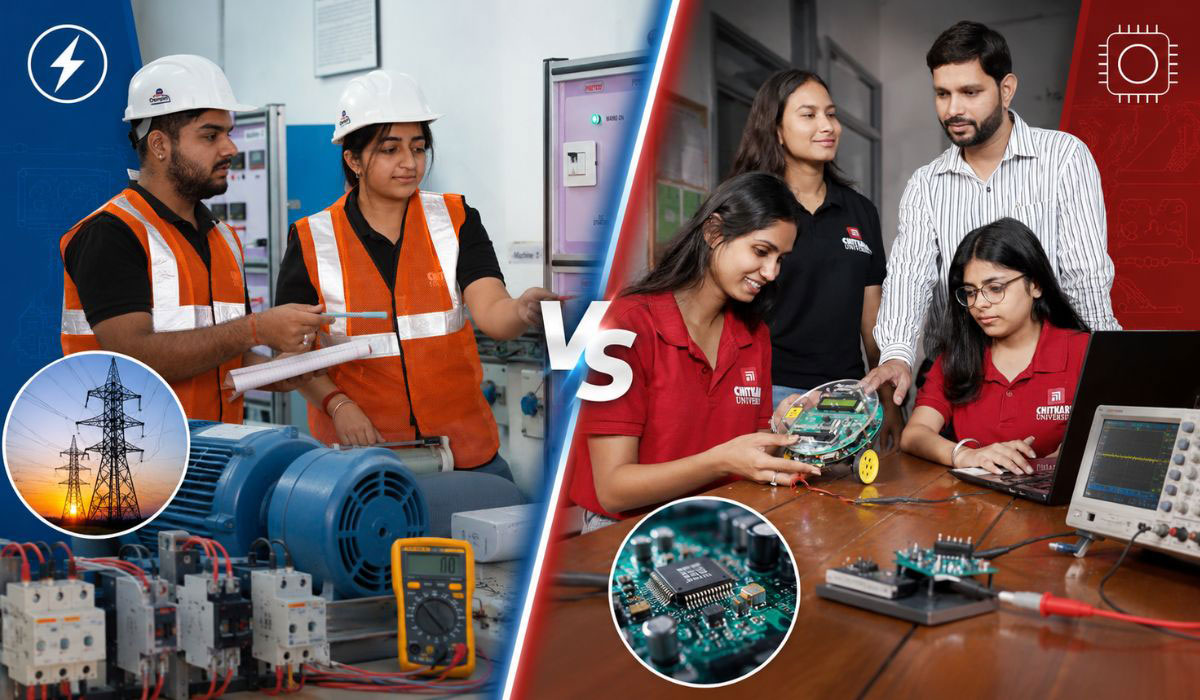

Which is Better for You – Electrical Engineering or Electronics Engineering? The choice between two of the most sought after disciplines is becoming increasingly relevant. As more industries become automated, jump on to the electric vehicle bandwagon, get on the renewable energy bandwagon, develop semiconductors, build robots, develop IoT and other AI enabled systems for day to day living, both Electrical Engineering and Electronics & Communication Engineering have a plethora of career options. Both Electrical Engineering and Electronics & Communication Engineering have tremendous career options, immense remuneration and huge industry demand in the year 2026. It is very important for a student to know the differences between ECE vs EE so that he or she can choose the right stream to pursue in college based on his or her academic profile, interest area and the career that he or she wishes to pursue in life.
As already mentioned, both Electrical Engineering and Electronics & Communication Engineering are based on same fundamental of Engineering. However the scope of application of both branches is quite different. Electrical Engineering deals with Power systems, Electricity generation and distribution, Industrial automation, Energy management etc. Electronics & Communication Engineering on the other hand deals with Semiconductors, Embedded systems, Communication technologies (Radio, Telephone, Satellite etc.), VLSI (Very Large Scale Integration) Design, Robotics, IoT (Internet of Things), and modern digital electronics and a host of other applications and products.
In the end it is up to the students as to what field they wish to specialize in. If you can help EE students to pursue designing of electric vehicles, or power systems or automation of industries or energy management, while you can help ECE students to design chips, or make AI devices, or coding or robotics or communication technologies or even modern digital electronics. There are huge placement opportunities in India as well as abroad. Also there are huge number of government jobs in both fields. There is huge future scope in both the fields as well.
Quick Answer: Electrical vs Electronics Engineering
Electrical Engineering (EE)
Focuses on:
- Power systems
- Electric vehicles
- Energy generation
- Industrial automation
- Electrical machines
- Renewable energy
Electronics & Communication Engineering (ECE)
Focuses on:
- Electronics circuits
- Semiconductors
- Communication systems
- Embedded systems
- IoT
- Robotics
- VLSI design
Which is Better in 2026?
- Choose Electrical Engineering if you are interested in power, EVs, energy systems, and automation.
- Choose ECE if you are interested in electronics, semiconductors, AI devices, robotics, and communication technologies.
Both fields have excellent future scope in India.
What is Electrical Engineering?
Electrical Engineering deals with:
- electricity generation,
- transmission,
- distribution,
- power systems,
- and industrial electrical technologies.
Electrical engineers work on large-scale systems that power industries, cities, transportation, and infrastructure.
Core Subjects in Electrical Engineering
- Power Systems
- Electrical Machines
- Control Systems
- Power Electronics
- Renewable Energy
- Industrial Automation
- High Voltage Engineering
What is Electronics & Communication Engineering (ECE)?
ECE focuses on:
- electronic devices,
- communication systems,
- embedded systems,
- and semiconductor technologies.
ECE engineers work on smart devices, telecommunications, robotics, satellites, and intelligent electronic systems.
Core Subjects in ECE
- Digital Electronics
- Microprocessors
- Embedded Systems
- VLSI Design
- Signal Processing
- Communication Systems
- IoT & Sensors
ECE vs EE: Major Differences
| Feature | Electrical Engineering (EE) | Electronics & Communication Engineering (ECE) |
| Core Focus | Power & electrical systems | Electronics & communication |
| Industry Areas | Power, EVs, automation | Semiconductors, telecom, IoT |
| Hardware Scale | Large-scale electrical systems | Small-scale electronic systems |
| Coding Requirement | Moderate | Higher |
| Government Jobs | Very strong | Strong |
| IT Sector Opportunities | Moderate | Very high |
| Emerging Technology Exposure | EVs, Smart Grids | AI devices, Robotics, Chips |
Skills Students Learn
Skills in Electrical Engineering
- Power management
- Automation systems
- Circuit analysis
- Renewable energy systems
- Industrial maintenance
- Electrical design
- Smart grid technologies
Skills in Electronics Engineering
- Embedded programming
- PCB design
- VLSI systems
- AI-integrated electronics
- Signal processing
- Robotics systems
- Communication technologies
Career Opportunities in Electrical Engineering
Electrical engineers are highly demanded across:
- power companies,
- EV industries,
- renewable energy,
- railways,
- manufacturing,
- and automation sectors.
Top Job Roles
- Electrical Engineer
- Power Engineer
- Automation Engineer
- Renewable Energy Engineer
- Control Systems Engineer
- Maintenance Engineer
- EV Systems Engineer
Career Opportunities in Electronics Engineering
ECE graduates have strong opportunities in:
- semiconductor industries,
- telecom,
- AI hardware,
- robotics,
- embedded systems,
- and IT companies.
Top Job Roles
- Electronics Engineer
- Embedded Systems Engineer
- VLSI Design Engineer
- IoT Engineer
- Robotics Engineer
- Communication Engineer
- Semiconductor Engineer
Salary Comparison: Electrical vs Electronics Engineering
Salary varies based on:
- technical skills,
- internships,
- certifications,
- and industry demand.
Average Salary in India (2026)
| Branch | Average Entry Salary |
| Electrical Engineering | ₹4.5 – ₹9 LPA |
| Electronics Engineering | ₹5 – ₹12 LPA |
High-Paying Sectors
Electrical Engineering
- EV Companies
- Renewable Energy
- Automation Industries
- Smart Infrastructure
Electronics Engineering
- Semiconductor Companies
- Chip Design Firms
- Telecom Industry
- Robotics & AI Hardware
ECE graduates currently have slightly higher salary potential in semiconductor and AI-driven industries.
Future Scope of Electrical Engineering in India
Electrical Engineering is witnessing major growth due to:
- Electric Vehicles (EVs)
- Renewable Energy
- Smart Grids
- Industrial Automation
- Sustainable Infrastructure
India’s focus on clean energy and EV adoption is creating massive demand for electrical engineers.
Emerging Areas
- EV Battery Systems
- Solar Power Systems
- Energy Storage
- Smart Power Distribution
- Industrial Automation
Future Scope of Electronics Engineering in India
Electronics Engineering has become one of the fastest-growing engineering fields because of:
- semiconductor manufacturing,
- AI-powered devices,
- IoT,
- robotics,
- and digital communication.
India’s semiconductor mission and increasing electronics manufacturing are driving strong demand for ECE professionals.
Emerging Areas
- Semiconductor Design
- AI Chips
- Robotics
- Embedded AI Systems
- 5G & 6G Technologies
- IoT Devices
Which Engineering Branch is Better in 2026?
Choose Electrical Engineering if:
- You enjoy physics and electrical systems.
- You want to work in EVs or renewable energy.
- You prefer industrial and infrastructure technologies.
- You are interested in government sector jobs.
Choose Electronics Engineering if:
- You enjoy coding and electronics.
- You are interested in AI devices and semiconductors.
- You want opportunities in robotics and IoT.
- You want stronger IT-sector integration.
Best Universities for EE & ECE in India
Several universities offer future-focused Electrical and Electronics Engineering programs.
Popular Universities
- IITs
- NITs
- Chitkara University
Chitkara University Engineering Programs
Chitkara University offers:
- B.E. in Electrical Engineering
- Electronics & Communication Engineering
- AI-integrated engineering programs
- Industry-driven specializations
The programs focus on:
- practical learning,
- automation,
- emerging technologies,
- research,
- and strong industry exposure.
Students gain access to:
- advanced laboratories,
- industrial training,
- live projects,
- and placement opportunities with leading global recruiters.
Conclusion
Whether it is emerging trends of 2026 or otherwise, be it Electrical or Electronics Engineering, both have come a long way in this technological world and are rapidly evolving to adapt to new trends in the technology-driven economy. Whether it is electric vehicles, renewable energy, automation or smart city’s infrastructure-EE has a lot to offer. On the other hand, area of interest for Electronics & Communication Engineering is rapidly evolving with large scale growth happening in area of semiconductors, robotics, AI devices, IoT devices and digital communication systems etc.
Thus, it’s not wise to pick a discipline on the basis of trends. Instead, one should test his/her aptitude, interest, and above all career goals in long run for EE as well as ECE has lot of future scope, can offer global opportunities to work for Indian as well as Multi National Companies, and are also having very high salaries in India and abroad. In industries all are now automating their processes and therefore intelligent systems and many advanced technologies required to run these automated systems. Thus, lots of opportunities are waiting for EE and ECE students for working and growing in those companies to design and implement intelligent automated systems.
Electrical vs Electronics Engineering at Chitkara University: Which Branch Is Better for Career in 2026?
The key deciding factor between two programs would be to determine which would be better for a candidate’s career in 2026. If you’re still stuck between two hens and unsure which way to go, take a look at two B.E. programs offered by Chitkara University – the Electrical Engineering program and the Electronics & Communication Engineering program. While both programs are very modern, they cater to two different industries in the market. Both the programs incorporate mandatory industrial training, ranging from 6 months to a year and the students are placed in the best of industries. The EE students at Chitkara can even opt for a Minor in Computer Science Engineering from the second semester and in the interim, learn the coding skills in AI, Data Science and Cyber Security.
In the Electrical Engineering program, students can specialize in study areas like power systems, renewable energy, automation, and electrical machines. They can gain hands-on learning experience in areas of Power Electronics, Control Systems, and industrial automation. Many industries like Schneider Electric, Fuji Electric, Siemens etc support the labs. On the other hand, in the Electronics & Communication Engineering program, students specialize in subjects like embedded systems, IoT, VLSI, robotics, wireless communication, and latest in electronics technology. Students can also gain expertise in subjects like Machine Learning, Deep Learning, Embedded Systems and Industry 4.0 on the latest platforms supported by industries like Nvidia, Texas Instruments, Micron etc.
The placements for both EE as well as ECE students are excellent. The median salary of engineering students has gone up to ₹9.85 LPA this year. Top students have even bagged salaries of up to ₹1.1 Crore from Amazon. EE students can look to get placed as Power Engineers, Automation Engineers, Renewable Energy Engineers and Control Systems Engineers. On the other hand, ECE students can get placed as Embedded Systems Engineers, Telecom Engineers, Hardware Engineers and Electronics Design Engineers. Even top global companies like Google, Microsoft, HP, Toshiba, Qualcomm, Samsung, Schneider Electric, Texas Instruments, Reliance Industries and many more recruit students from the university.